


Table of Contents
- Signs of a Bad Circuit Breaker You Should Never Ignore
- How to Tell a Tripped Breaker From a Faulty One
- How to Reset a Main Electrical Breaker After an Outage
- What It Costs to Replace a Circuit Breaker
- When to Replace Electrical Breakers Instead of Resetting Them
- Repair or Replace the Whole Panel? A Cost-Benefit Breakdown
- AFCI and GFCI Requirements: What Today’s Code Expects
- Frequently Asked Questions
Last Updated: September 10, 2026
Signs of a Bad Circuit Breaker You Should Never Ignore
Knowing when to replace electrical breakers starts with recognizing the warning signs your panel gives you. Most breaker failures announce themselves through heat, smell, and visible damage homeowners overlook until it’s too late.
A circuit breaker automatically interrupts current when it detects an overload or short circuit, protecting your wiring. When it fails, the consequences range from nuisance tripping to fire risk.
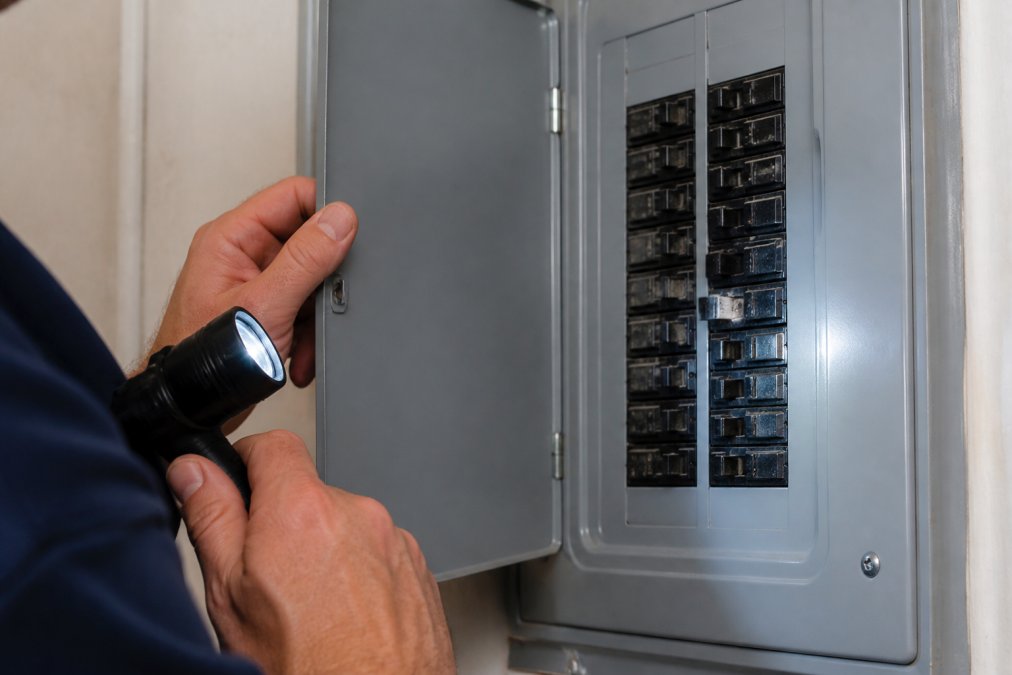
Visual Warning Signs: Scorching, Melting, and Discoloration
Discolored or scorched breakers indicate heat damage that has already compromised the device. Don’t assume a browned breaker still works because it hasn’t tripped yet.
Look for these visual indicators during any panel inspection:
- Black soot or scorch marks around the breaker switch
- Melted or warped plastic housing
- Brown or yellow discoloration on the breaker face
- Corrosion on the bus bar connections
Any of these signs means the breaker has been overheating: its contacts are likely pitted or welded, so it can no longer trip reliably.
A breaker with visible scorch marks may still appear to function, but its internal mechanism is compromised. Continuing to use it creates a fire risk because it won’t trip during an actual overload.
Burning Smells and Breakers That Feel Hot to the Touch
A burning smell near your electrical panel is never normal (esfi.org). That acrid, metallic odor indicates insulation breakdown or arcing inside the breaker or its wiring.
Breakers that feel hot to the touch present a subtler problem. Under normal load, a breaker should be warm at most. If it’s hot enough that you pull your hand back, the circuit is drawing more current than the breaker can handle, or the breaker has excessive internal resistance.
Shut off the main power and call a licensed electrician if you notice either symptom. These aren’t issues to troubleshoot on your own.
How to Tell a Tripped Breaker From a Faulty One
A tripped breaker is doing its job; a faulty breaker has stopped doing its job. Distinguishing between the two saves you from replacing a working device.
Tripped breaker indicators:
- Switch sits in the middle position or slightly off from “ON”
- Resets cleanly and holds
- Trips only under heavy electrical load
- No physical damage or odor
Faulty breaker indicators:
- Trips repeatedly with minimal load
- Won’t reset at all, or feels loose when you flip it
- Shows visible damage, heat marks, or corrosion
- Emits a burning smell
- Feels hot even when the circuit is lightly loaded
If your breaker trips once during a heat wave with the AC, dryer, and microwave running, that’s an overload doing its job, reset it and manage your load. If it trips three times in a week with nothing unusual running, the breaker or circuit has a problem.
How to Reset a Main Electrical Breaker After an Outage
Resetting a main breaker after an outage follows a specific sequence to prevent damage to your appliances and electrical system. Knowing whether it tripped for a normal reason or a dangerous one is what separates a safe homeowner from a statistic.
The Reset Sequence
- Turn off all major appliances and electronics at their switches
- Open the electrical panel door and locate the main breaker at the top
- Push the main breaker switch firmly to the “OFF” position
- Wait 30 seconds to allow the mechanism to reset
- Push the switch firmly to “ON”
- Restore power to appliances one at a time, starting with the largest loads
If the main breaker trips again immediately after resetting, do not keep flipping it. That pattern indicates a serious fault in the electrical service or panel that requires professional diagnosis.
After an outage, wait a full minute before resetting your main breaker. This gives compressors in your AC and refrigerator time to depressurize, preventing them from stalling on startup and tripping the breaker again.
Safe Homeowner Testing Before You Call a Pro
Most guides stop at “call an electrician,” leaving you unable to tell a nuisance trip from a genuine hazard. A few non-invasive checks, done with the panel closed and no tools inside it, can tell you a lot.
The load test. Note what was running when the breaker tripped. If the AC, dryer, and microwave were all on, you likely hit an overload. If it tripped with almost nothing running, that points to a fault.
The reset-and-hold test. Reset the breaker once. If it holds and the circuit works normally, you had a transient overload. If it trips again within minutes under the same light load, stop resetting it.
The outlet tester. An inexpensive plug-in tester confirms whether outlets on the affected circuit are wired correctly and whether a GFCI works. It won’t diagnose a failing breaker, but it rules out a downstream wiring fault that would otherwise look like one.
The multimeter check (advanced). A homeowner comfortable with a multimeter can verify voltage at an outlet on the affected circuit with the breaker on. Near zero volts means the breaker or circuit is open. This is a diagnostic, not a repair, do not open the panel to test the breaker itself.
Never remove the panel cover, touch the bus bar, or probe inside the panel. The main lugs remain energized even with the main breaker off. All in-panel testing is a job for a licensed electrician.
What Your Test Results Mean
| What you observed | Likely cause | Next step |
|---|---|---|
| Tripped once during heavy load, reset held | Normal overload | Manage load, monitor |
| Trips repeatedly under light load | Failing breaker or circuit fault | Call an electrician |
| Outlet tester shows miswiring | Downstream wiring issue | Call an electrician |
| Breaker feels hot or smells burnt | Internal breaker failure | Shut off, call immediately |
| Main breaker won’t reset at all | Service or panel fault | Call immediately |
The goal of homeowner testing isn’t to fix anything, it’s to arrive at the phone call with useful information. “My breaker trips every time the microwave runs” is far more actionable than “my breaker keeps tripping.”
What It Costs to Replace a Circuit Breaker
Breaker replacement pricing breaks into three parts: the breaker itself, the labor to install it, and diagnostic time to confirm the breaker, not the circuit it protects, is the problem. Knowing which dominates your bill tells you whether you’re looking at a small repair or a panel upgrade.
The breaker (parts). Standard single-pole breakers are the least expensive component. Double-pole breakers cost more because they occupy two slots and handle 240-volt loads like dryers, ranges, and AC condensers. Specialty arc-fault or ground-fault breakers carry a premium for their added sensing circuitry. The breaker is usually the smallest line item, labor typically exceeds parts for a single-device swap.
The labor. A straightforward swap of one breaker in an accessible panel is a short job. Costs rise when:
- The panel is in a tight closet, crawlspace, or behind finished drywall
- The bus bar is corroded or pitted and needs cleaning or replacement
- The circuit must be traced and tested to confirm the breaker is the fault
- The replacement requires a permit and inspection
The diagnostic. This is the line item homeowners most often overlook. A licensed electrician doesn’t just swap the part you point at, they verify the breaker failed rather than the wiring, load, or a loose neutral. Skipping that step is how people end up replacing the same breaker twice.
Why a Quote Without a Diagnosis Is Worthless
If a contractor quotes a breaker swap without inspecting the panel, bus bar, and circuit, the price is meaningless. The real question isn’t “what does a breaker cost”, it’s “what is actually failing.” A breaker that trips because of a damaged wire will keep tripping after replacement.
When the Math Flips Toward a Panel Upgrade
Individual breaker replacement is almost always cheaper than a panel upgrade, until it isn’t. The crossover point arrives when:
- You’re replacing a third or fourth breaker in the same panel
- The panel brand has known safety issues or discontinued breakers that are hard to source
- The service amperage is too low for your load, so breakers trip regardless of condition
- The panel is old enough that the bus bar and enclosure are also at end of life
At that point, repeated single-breaker swaps are money thrown at a system that needs replacing as a unit. A panel upgrade costs more upfront but stops the recurring repair cycle.
Ask any electrician for a quote that separates parts, labor, and diagnostic time. A transparent quote lets you see whether you’re paying for a device or for the expertise to identify the right device.
Voltedge Electrical provides itemized quotes before any work begins. We assess the panel, confirm the actual failure point, and give you a clear price with no surprise charges once work starts. For current pricing on breaker replacement, contact us for a quote.
When to Replace Electrical Breakers Instead of Resetting Them
Replace electrical breakers when they show physical damage, trip repeatedly under normal loads, or fail to reset properly. Resetting works for overloads. Replacement is necessary for mechanical failure.
How Long Residential Breakers Last and What Shortens Their Life
Most residential breakers last 30 to 40 years under normal conditions. Several factors shorten that lifespan:
- Frequent tripping wears down the internal mechanism
- Excessive heat from overloaded circuits degrades contacts faster
- Corrosion from humidity affects panels in garages or near coastal areas
- Loose connections create arcing that damages the breaker and bus bar
A 35-year-old breaker that has tripped dozens of times is living on borrowed time, even if it looks fine outside.
Manufacturer recalls also affect specific breaker models. Check whether your panel’s brand has any active recalls before assuming an old breaker is safe.
Repair or Replace the Whole Panel? A Cost-Benefit Breakdown
Replacing individual breakers makes sense when the panel is in good condition and only one or two devices have failed. Replacing the entire panel is the better investment when multiple breakers show wear, the panel is undersized, or the brand has known safety issues.
| Situation | Recommended Action | Why |
|---|---|---|
| One breaker tripping repeatedly | Replace individual breaker | Panel and bus bar are likely fine |
| Multiple breakers showing heat damage | Replace entire panel | Widespread failure indicates systemic issue |
| 100-amp panel with modern appliances | Panel upgrade | Insufficient capacity for current electrical load |
| Panel older than 40 years | Full evaluation, likely replacement | Components past expected lifespan |
| Fuses instead of breakers | Panel upgrade | Fuse panels can’t meet modern NEC code |
A 100-amp panel in a 1970s home often can’t handle today’s demand. Adding an EV charger, tankless water heater, or mini-split pushes those older panels past their limits. Upgrading to 200-amp service costs more upfront but eliminates the cycle of constantly replacing failed breakers.
AFCI and GFCI Requirements: What Today’s Code Expects
Modern electrical code requires arc-fault circuit interrupter (AFCI) and ground-fault circuit interrupter (GFCI) protection in specific areas of your home. The National Fire Protection Association’s NEC code information outlines these requirements, which have expanded significantly over the past two decades.
GFCI breakers protect against electrical shock by monitoring current flow and cutting power when it detects a ground fault. They’re required in bathrooms, kitchens, garages, outdoors, and near water sources.
AFCI breakers detect dangerous electrical arcs that can ignite insulation or framing inside walls. They’re required in bedrooms, living areas, and other living spaces.
If your panel uses standard breakers in areas that now require AFCI or GFCI protection, upgrading those circuits brings your home into compliance and adds a genuine safety layer. The U.S. Consumer Product Safety Commission notes that electrical failures cause thousands of home fires annually, many preventable with proper circuit protection.
Older homes often have no AFCI or GFCI protection at all. When you’re already replacing breakers, upgrading the affected circuits to AFCI or GFCI models costs little more and delivers meaningful protection.
The most important decision isn’t whether to replace a breaker, it’s whether you’re addressing the symptom or the cause. One failed breaker points to a device problem. Multiple failures point to a panel problem.
Your electrical panel is the heart of your home’s power system, and ignoring warning signs from failing breakers puts your property and family at risk. Voltedge Electrical’s licensed and insured electricians handle breaker replacement and panel upgrades with transparent pricing and 24/7 emergency availability. We provide customized solutions for older homes, EV charger installations, and whole-house surge protection, all backed by up-to-date knowledge of current electrical codes. Get started with Voltedge Electrical and give your property the safe, reliable power it deserves.
Frequently Asked Questions
How do I know if a breaker needs to be replaced?
A breaker needs replacement when it trips repeatedly under normal electrical load, feels hot to the touch, smells like burning, shows scorch marks or melting, or will not stay reset. Breakers that trip once during a storm and reset cleanly are usually fine. If the same breaker trips three or more times in a month without an obvious overload, call a licensed electrician to test it. Ignoring these signs raises fire risk and can damage wiring behind the walls.
How much do electricians charge to replace a breaker?
The cost to replace circuit breaker units varies with breaker type, amperage, panel brand, and whether the panel has room for new hardware. AFCI and GFCI breakers may cost more than standard units because of their electronics. Pricing also depends on labor, permits, and any panel repairs needed. Voltedge Electrical does not publish flat rates because every job differs, so request a written quote before work begins to avoid surprise charges.
Can I replace a 20 amp breaker with a 30 amp breaker?
No. Breaker size must match the wire gauge it protects. A 20-amp circuit typically uses 12-gauge wire, and swapping in a 30-amp breaker lets the wire carry more current than it can handle safely, which can overheat the insulation and start a fire. The National Electrical Code requires the breaker to protect the conductor. If you need more capacity, an electrician must upgrade the wire and possibly the circuit.
What is the 80% rule for circuit breakers?
The 80% rule means a breaker should carry no more than 80% of its rating during continuous loads lasting three hours or more. A 20-amp breaker, for example, should handle a sustained 16 amps. This rule applies to appliances like EV chargers, space heaters, and commercial equipment. If a circuit runs near its limit for hours, the breaker heats up and trips or wears out faster, which shortens its lifespan.
