


Table of Contents
- Why Hot Weather Makes Breakers Trip
- AC Circuit Breaker Keeps Tripping: Is Your Air Conditioner the Culprit?
- Signs of an Overloaded Electrical Circuit
- Step-by-Step: What to Do When a Breaker Trips
- Smart Home Monitoring for Your Electrical System
- When to Call a Professional Electrician
- Frequently Asked Questions
Last Updated: September 14, 2026
Why Hot Weather Makes Breakers Trip
Troubleshooting tripping breakers in summer starts with understanding that heat, not just demand, is often the trigger. A circuit breaker is a thermal-magnetic device: it trips when current exceeds its rating (magnetic) or when a bimetallic strip inside heats past a set threshold (thermal). When ambient temperature around your panel climbs, that strip needs less current to trip.
Panels in garages and utility closets where afternoon temperatures push past 100°F can experience nuisance-tripping under normal loads, even for breakers that held all winter. The breaker isn’t broken, it’s doing what physics dictates in a hotter environment.
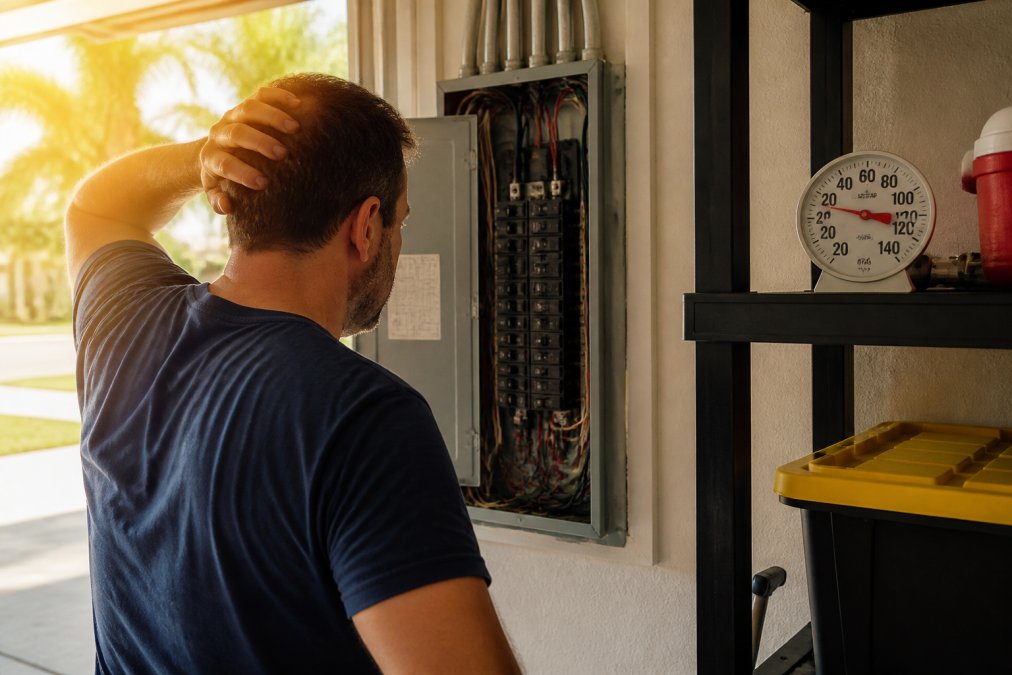
How Heat Affects Your Electrical Panel
Every breaker carries a temperature rating tied to a standard ambient baseline, typically around 86°F for residential equipment. Above that baseline, its effective capacity derates: a 20-amp unit may trip closer to 16 or 17 amps of sustained load once the surrounding air heats up.
Heat dissipation matters just as much. Breakers shed heat through their casings and the panel enclosure. A panel packed with breakers, sealed in a hot closet, or in direct sun has nowhere for that heat to go, so ordinary summer demand is enough to trip an overloaded circuit.
The NFPA overview of electrical safety in the home notes that electrical distribution equipment is tested to specific ambient conditions, which is why installation environment matters as much as amperage rating.
A common mistake is replacing a tripping breaker with a higher-amperage one. That doesn’t fix heat derating; it removes a safety layer and can overheat the wiring the breaker was protecting. Match the breaker to the wire, not to the annoyance.
AC Circuit Breaker Keeps Tripping: Is Your Air Conditioner the Culprit?
When an AC circuit breaker keeps tripping, the air conditioner is the most common summer suspect. A central AC unit draws its heaviest current at compressor startup, when locked-rotor inrush can briefly spike several times above the running load. Add a hot garage panel and a compressor fighting high outdoor temperatures, and that circuit sits near its trip threshold all afternoon.
Most guides stop at “your AC is drawing too much.” The useful version ties each AC failure mode to the load it puts on the breaker.
AC Maintenance Checklist Mapped to Breaker Load
- Air filter. A clogged filter restricts airflow across the evaporator coil, dropping suction pressure and forcing longer compressor cycles, sustained current closer to the breaker’s rating instead of short bursts. Replace or clean monthly during peak season.
- Evaporator and condenser coils. Dirty coils reduce heat exchange on both sides. The condenser coil is the one homeowners ignore: matted with grass, lint, or cottonwood, it raises head pressure and compressor amp draw, and the breaker sees a load it wasn’t sized for. Rinse it from the inside out with the unit off.
- Run capacitor. A weak run capacitor makes the compressor and condenser fan motor draw higher current for the same torque. A bulged or leaking capacitor is a visual giveaway; a technician measures microfarads against the nameplate. This is a common cause of a summer trip that resets fine, then trips again an hour later.
- Start capacitor and potential relay (on units so equipped). These reduce inrush at startup. When they fail, inrush climbs and the breaker trips within seconds of the compressor kicking on, a very different signature from a heat-related trip.
- Contactor. Pitted or welded points cause intermittent voltage drop and arcing, showing up as a breaker that trips unpredictably rather than on a schedule.
- Refrigerant charge. An undercharged or overcharged system runs at abnormal pressures, and the compressor compensates with higher current. Charge is not a DIY adjustment; it requires gauges and a licensed technician.
- Condenser fan motor. A failing fan motor raises head pressure and amp draw, often tripping the breaker on the hottest part of the day.
Reading the Trip Pattern
The timing of the trip tells you which of the above to suspect first:
- Trips within seconds of startup, every time: suspect the start components, a seized compressor, or a short in the compressor windings. Stop resetting it.
- Trips after 20-60 minutes of running, only on hot afternoons: suspect heat derating of the breaker combined with a marginal circuit, or a capacitor/charge issue raising steady-state draw.
- Trips intermittently, no clear pattern: suspect the contactor, a loose connection at the disconnect or panel, or a failing breaker itself.
A clamp meter reading at the AC disconnect, taken by a qualified person, is the fastest way to compare running amps against the nameplate RLA (rated load amps). If the unit pulls above nameplate, the problem is mechanical or refrigerant-side, not the breaker.
The DOE guidance on air conditioning efficiency and maintenance explains how dirty filters and restricted airflow force a system to run longer and harder, which raises current draw on the circuit.
Before you call anyone, write down three things: the outdoor temperature when it tripped, how long the AC had been running, and whether it tripped at startup or mid-cycle. That pattern narrows the cause faster than any single meter reading.
Signs of an Overloaded Electrical Circuit
Recognizing the signs of an overloaded electrical circuit early prevents repeat trips and reduces fire risk. An overloaded circuit, total connected load exceeding the breaker’s rated capacity, announces itself before it fails.
Watch for these signals:
- Breakers that feel warm or hot to the touch
- A burning or fishy smell near the panel
- Lights that dim or flicker when large appliances start
- Breakers that trip repeatedly on the same circuit
- Discolored or scorched outlet faceplates
- Buzzing from the panel or outlets
One or two of these on an occasional basis can be normal. Three or more, or any burning smell, means the circuit needs evaluation now. Overloaded circuits are a leading cause of residential electrical fires, and the US Fire Administration electrical fire data tracks how often distribution faults contribute to home fires.
Never ignore a breaker that trips, resets, and trips again within minutes. Repeated tripping means the fault is still present. Forcing the breaker to stay on, or taping it in the on position, defeats the protection and can ignite wiring inside a wall.
Step-by-Step: What to Do When a Breaker Trips
A tripped breaker is a symptom, not the problem. Follow these steps in order, and stop if anything smells burnt or looks damaged.
- Unplug or turn off devices on the affected circuit.
- Locate the tripped breaker in your panel; it sits between on and off, or fully off.
- Push it fully to OFF, then firmly to ON. A half-flip won’t reset it.
- Restore loads one at a time, pausing between each to see if it holds.
- Note which device triggers the trip; that device or its circuit is the issue.
- If it trips with nothing plugged in, the fault is in the wiring or the breaker itself.
- If it trips again immediately, stop and call a licensed electrician.
How to Reset Main Electrical Breaker After Outage
Knowing how to reset main electrical breaker after outage safely matters because the main differs from a branch breaker. After an outage, turn off the main and the largest branch breakers, switch the main on, then bring circuits back one at a time. This staged approach avoids simultaneous inrush from every appliance, a common reason a main trips right after power returns.
DIY Safety Testing Protocols
You can safely do a few checks yourself, and no more. Test that the breaker resets with no load, use a plug-in circuit tester on outlets, and check whether a specific appliance consistently triggers the trip. Do not open the panel cover, probe live terminals, or test amperage with a multimeter beyond your training. Panel interiors hold lethal voltage even with the main off in some configurations, which is why OSHA electrical safety guidance treats panel work as qualified-person territory.
Smart Home Monitoring for Your Electrical System
Smart monitoring is the angle most guides skip, and it’s genuinely useful for a recurring summer problem. Instead of guessing which appliance pushes a circuit over, you watch the numbers in real time.
What the Hardware Actually Does
Two categories matter for summer breaker troubleshooting:
- Whole-home energy monitors. These install at the panel with current transformers (CTs) clamped around the main service conductors and, on some models, individual branch circuits. They sample current many times per second and report to a phone app, with resolution down to a few watts per circuit, fine enough to separate a compressor’s startup spike from its running load.
- Smart circuit breakers. These replace standard branch breakers in compatible panels and add per-circuit metering, remote switching, and timestamped trip-event logging, recording not just that a breaker tripped but when, and the current in the seconds before.
Why This Beats Guesswork in Summer
A marginal AC circuit is a timing problem: the breaker holds at 2 p.m. and trips at 4 p.m. because panel ambient temperature rose a few degrees and the compressor’s running amps crept up with head pressure. A monitor turns that invisible overlap into a graph:
- You can see the compressor’s inrush spike at startup, often several times the running amps, and confirm whether it’s climbing over weeks as the unit ages.
- You can see sustained running load and whether it’s drifting toward the breaker’s rating on hot afternoons.
- You can see whether a second appliance on the same circuit (a garage freezer, a window unit, a pool pump) is the final straw that pushes a marginal circuit over.
- Trip-event logs let you correlate trips with outdoor temperature, time of day, and which loads were active, the same load log a good electrician would ask you to keep, but automatic.
What Monitoring Cannot Do
Monitoring tells you what is happening, not why. It will show a circuit drawing 18 amps on a 20-amp breaker at 3 p.m.; it won’t tell you whether the cause is a failing capacitor, a loose neutral, or a breaker out of calibration. It also doesn’t replace a proper load calculation, which accounts for continuous versus non-continuous load, conductor ampacity, and the 80% rule. Treat monitoring as a diagnostic aid that makes the electrician’s visit faster and more targeted, not as a fix.
If you install one thing this summer, install a whole-home monitor with per-circuit CTs. The first heat wave will show you exactly which circuit is marginal, usually before it starts nuisance-tripping, and give you data to hand an electrician instead of a description.
When to Call a Professional Electrician
Call a licensed electrician when a breaker trips repeatedly, when you smell burning, when the panel is warm, or when your home still runs on an older 100-amp service feeding modern loads. These aren’t DIY problems, and the consequences range from a ruined appliance to a house fire.
Voltedge Electrical provides comprehensive electrical solutions for residential and commercial clients throughout Southern Florida. Our team of certified professionals delivers high-quality workmanship, ranging from panel upgrades and lighting installations to 24/7 emergency services. We are dedicated to powering your property safely and efficiently with a focus on integrity, reliability, and future-ready innovation. If you’re weighing whether an older panel can keep up, have that conversation before the next heat wave rather than during it. Our team also installs whole-house surge protection and EV chargers, both of which add load an aging panel may not tolerate without an upgrade.
VoltEdge Electric is bar none one of the most professional and most responsive vendors we have at Keyrenter South Florida.
The single most useful habit for summer breaker problems is a load log: note which breaker trips, at what time of day, and what was running. That one page of notes tells an electrician more in five minutes than an hour of guessing.
Summer heat exposes every weak point in an electrical system, from a derated breaker to a compressor drawing more current than its circuit can safely carry. If tripping breakers have become a weekly event, the fix isn’t a bigger breaker; it’s a proper evaluation. Voltedge Electrical provides comprehensive electrical solutions for residential and commercial clients throughout Southern Florida. Our team of certified professionals delivers high-quality workmanship, ranging from panel upgrades and lighting installations to 24/7 emergency services. We are dedicated to powering your property safely and efficiently with a focus on integrity, reliability, and future-ready innovation. Inquire now and get your system assessed before the next heat wave finds the weak spot for you.
Frequently Asked Questions
Why does my circuit breaker keep tripping in the summer?
Summer heat raises the ambient temperature in your home, especially in garages or utility closets where panels are often located. This heat reduces the breaker’s ability to dissipate heat from normal current flow, causing it to trip earlier than usual. Combined with increased electrical load from air conditioning and appliances, your system can easily exceed its rated capacity. If tripping continues after resetting, call a licensed electrician for a professional inspection.
Can high humidity cause a circuit breaker to trip?
Yes, high humidity can contribute to tripping. Moisture in the air can enter electrical panels and outlets, leading to corrosion, loose connections, and even ground faults. In Southern Florida’s humid summers, this is a common issue. If you notice a musty smell or corrosion around your panel, have a professional inspect it. They can check for wiring faults and ensure your system is safe.
What temperature is too hot for a circuit breaker?
Most residential circuit breakers are rated for a maximum ambient temperature of 40°C (104°F). When the surrounding air exceeds this, the breaker’s thermal-magnetic mechanism may trip prematurely. In a hot garage or utility room, temperatures can easily reach this threshold. Keep your panel area ventilated and out of direct sunlight. If your breaker box feels hot to the touch, call an electrician to assess the situation.
How do I reset my main electrical breaker after an outage?
First, turn off all sensitive electronics. Locate your main breaker at the top of the panel. If it’s tripped, it will be in the middle or ‘off’ position. Push it firmly to ‘off,’ then switch it back to ‘on.’ If it trips immediately, do not force it. This indicates a serious fault. Contact a licensed electrician to troubleshoot the issue safely. Never reset a breaker while standing in water.
