


Table of Contents
- Why Commercial EV Charging Solutions Matter for Your Business
- Level 2 vs DC Fast Charging for Commercial Use
- Commercial EV Charging Station Installation Costs and ROI
- Commercial Electrical Code Compliance for EV Chargers
- Key Features to Evaluate in Commercial EV Charging Solutions
- Total Cost of Ownership and Government Incentives
- Choosing the Right Solution for Your Business
- Frequently Asked Questions
Last Updated: September 29, 2026
Why Commercial EV Charging Solutions Matter for Your Business
Fleet operators, property managers, and commercial facility owners now face a critical decision: how to implement reliable commercial EV charging solutions that scale with their operations. Voltedge Electrical helps businesses evaluate infrastructure needs, understand compliance requirements, and select systems that deliver both immediate functionality and long-term ROI.
The challenge is building infrastructure that handles peak demand, integrates with existing electrical systems, remains compliant with evolving codes, and generates measurable value.
Level 2 vs DC Fast Charging for Commercial Use
The distinction between Level 2 and DC fast charging fundamentally shapes your infrastructure investment. Level 2 chargers deliver 240-volt power and typically add 25-30 miles of range per hour. DC fast chargers operate at 480 volts or higher and can add 200+ miles in 30 minutes. For commercial applications, the choice depends on your specific use case.
Level 2 works best for businesses where vehicles park for extended periods: employee parking lots, fleet depots, or facilities where vehicles spend 8+ hours on-site. Installation costs are lower, electrical requirements are less demanding, and many businesses find Level 2 stations meet 80% of their charging needs at a fraction of the cost.
DC fast charging suits high-turnover scenarios: public charging networks, transit hubs, or commercial fleets that need rapid turnaround. The trade-off is substantial. DC fast charging requires dedicated electrical infrastructure, higher amperage feeds, and more complex load management. Installation complexity increases significantly, and operational costs rise accordingly.
Most successful commercial deployments use a hybrid approach: Level 2 stations for routine charging and strategic DC fast chargers for high-demand periods or customer-facing applications.
Commercial EV Charging Station Installation Costs and ROI
Installation expenses vary dramatically based on site conditions, electrical capacity, and charger type. Level 2 installations require electrical upgrades, trenching, and permitting. DC fast charging demands utility coordination, panel upgrades, and specialized electrical work.
The real question is total cost of ownership. Payback comes through employee retention, customer amenities, and reduced fleet operational costs. Commercial EV charging solutions can become revenue-generating assets through usage fees or membership models.
Voltedge Electrical conducts site assessments evaluating parking patterns, electrical capacity, future growth, and utility rates to right-size infrastructure and balance upfront investment with operational efficiency.
Commercial Electrical Code Compliance for EV Chargers
Compliance is foundational. The National Electrical Code (NEC) establishes standards for EV charger installation, including circuit protection, grounding, overcurrent protection, and safety disconnects. State and local jurisdictions often add specific requirements.
Load management is critical. Installing multiple high-power chargers without load balancing can trigger demand charges or utility penalties. Proper load management prevents simultaneous peak draws that exceed panel capacity.
Ground-fault protection, proper bonding, and isolation requirements are non-negotiable. Working with licensed electricians who understand current code requirements is essential. Voltedge Electrical stays current with NEC updates and local amendments to ensure every installation passes inspection and operates safely.
Key Features to Evaluate in Commercial EV Charging Solutions
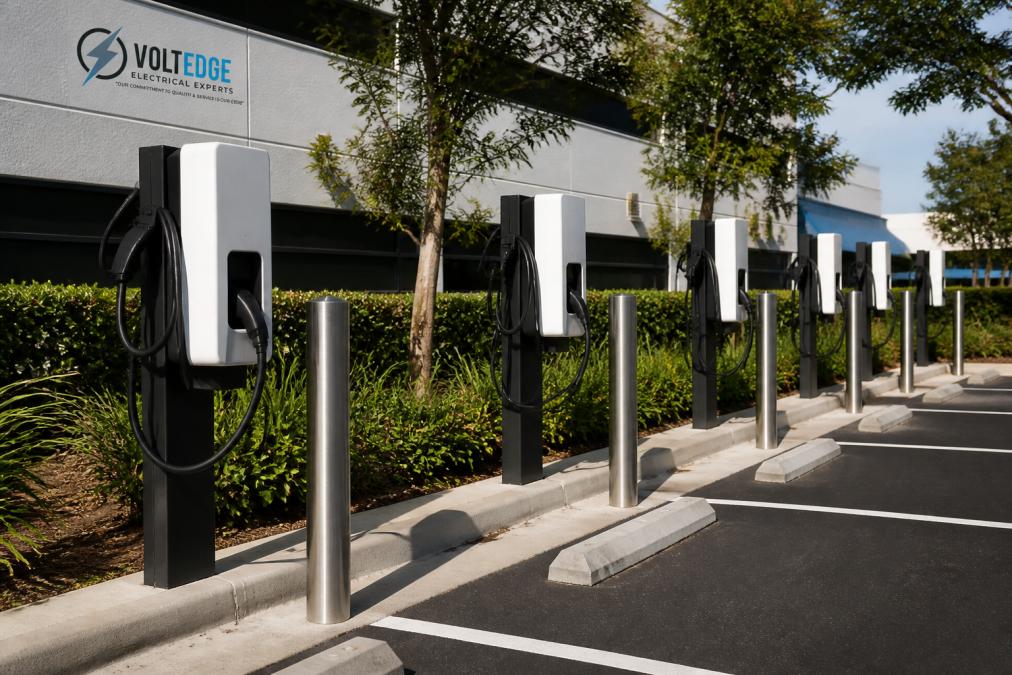
Load Management and Energy Optimization
Load management prevents electrical overload by distributing charging demand intelligently. Smart load management systems adjust power delivery in real-time based on grid availability and facility demand, preventing demand charges from utilities.
Systems that track consumption patterns and shift charging to off-peak hours can reduce operational costs. Intelligent load balancing prevents demand charges.
Hardware Interoperability and Open Standards
Vendor lock-in is a genuine risk in commercial charging infrastructure. Open standards like OCPP (Open Charge Point Protocol) ensure your chargers work across different networks and software platforms.
OCPP compliance means your chargers communicate with third-party management software, integrate with fleet telematics systems, and connect to public charging networks. This prevents vendor lock-in and allows you to mix charger brands and upgrade components independently as your network scales.
Real-Time Monitoring and Remote Diagnostics
Real-time monitoring shows usage patterns, revenue generation, equipment status, and fault conditions. Remote diagnostics allow technicians to identify and resolve issues without on-site visits, reducing downtime.
Monitoring systems provide granular data on utilization, peak usage times, and revenue per station. Remote diagnostics capability separates premium systems from basic ones.
Remote diagnostics allow technicians to identify and resolve faults remotely without a service truck visit. A charger offline due to a firmware glitch can be rebooted quickly, protecting revenue and customer satisfaction.
Maintenance SLAs and Uptime Guarantees
Downtime is a hidden cost many commercial buyers overlook. Request explicit Service Level Agreements (SLAs) that specify:
- Uptime guarantee: Most providers commit to high uptime.
- Mean Time to Repair (MTTR): How quickly will a technician respond to a fault? Some SLAs commit to specific response times for critical faults, with remote diagnostics reducing actual repair time.
- Preventive maintenance schedule: How often are chargers serviced? Annual inspections catch connector wear, electrical drift, and firmware updates before they cause failures.
- Spare parts availability: Does the vendor stock replacement connectors, power modules, and cables? Lead times for parts can extend downtime from days to weeks.
- Escalation procedures: If a charger fails and remote diagnostics cannot resolve it, what is the on-site response time? Is there a dedicated support line?
An SLA guaranteeing timely resolution for critical faults is valuable.
Vendors offer tiered SLAs. For mission-critical installations, a premium tier can be justified by downtime avoidance.
Integration with Fleet Management and Telematics
Fleet charging solutions should integrate with your fleet management platform, allowing automatic logging of charging sessions, cost allocation, and coordination with route planning.
Total Cost of Ownership and Government Incentives
Total cost of ownership encompasses installation, equipment, electrical infrastructure, maintenance, software licensing, and operational expenses over 10 years. Lower upfront cost may mean higher long-term costs if maintenance or software fees are high.
Breaking Down TCO Components
Installation costs vary by charger type and site conditions. Over 10 years, also factor in:
- Software and connectivity licensing: $50-$200 per charger annually for monitoring, load management, and reporting platforms
- Maintenance and repairs: 2-3% of hardware cost annually for Level 2; 3-5% for DC fast chargers
- Electricity costs: Varies by utility rate and usage; time-of-use rates can reduce costs 15-20% with smart load management
- Replacement parts and battery degradation: Connectors, cables, and power electronics degrade over time
Federal Tax Credits and Incentives
The federal Investment Tax Credit (ITC) under Section 30C allows businesses to claim 30% of qualified commercial charging equipment and installation costs, including associated electrical infrastructure. The credit can be carried back one year or forward 20 years.
Eligibility requirements:
- The charger must be installed at a commercial property (not residential)
- It must be placed in service during the tax year you claim the credit
- You must own or have a long-term lease on the property (typically 3+ years)
- The charger must meet Department of Energy efficiency standards
State and Utility Incentives
Many states layer additional incentives on top of federal credits. Many states layer additional incentives on top of federal credits. Utility incentives often target demand reduction.
ROI Timeline with Incentives
Consider a real-world example: A fleet operator installs Level 2 chargers. Without incentives, payback depends on usage fees or avoided fuel costs. With federal and state credits, the net cost drops. If the facility generates usage fees or fuel savings, payback occurs more quickly. Over a 10-year lifecycle, the incentive-adjusted ROI can be substantially stronger.
Incentive Application Timing
Many businesses make the mistake of installing chargers first, then applying for incentives retroactively. Some programs require pre-approval before installation. Others require installation by a certified contractor. Timing matters: federal credits can be claimed on your tax return for the year the charger is placed in service, but state rebates often have application deadlines and limited funding pools.
Choosing the Right Solution for Your Business
The best commercial EV charging solution matches your specific operational needs, electrical capacity, and growth trajectory. Start by auditing current usage patterns: how many vehicles need charging, how long they park, and what power levels they require. Assess your electrical infrastructure: available capacity, panel location, and utility rate structure.
| Evaluation Factor | Level 2 Charging | DC Fast Charging | Hybrid Approach |
|---|---|---|---|
| Installation Cost | Lower | Higher | Moderate |
| Space Requirements | Compact | Requires dedicated area | Mixed |
| Power Delivery Speed | 25-30 mi/hr | 200+ mi/30 min | Both options available |
| Best For | Employee parking, fleet depots | Customer-facing, high turnover | Most commercial sites |
| Electrical Demand | Moderate | Substantial | Balanced |
| Load Management Complexity | Low | High | Medium |
Frequently Asked Questions
What factors should businesses consider when choosing a commercial EV charging solution?
Evaluate power output (Level 2 vs DC fast charging), load management capabilities, OCPP compliance for interoperability, uptime SLAs, real-time monitoring features, and total cost of ownership including installation and maintenance. Consider your fleet size, charging frequency, and whether you need white-label software for branding. Verify the provider supports hardware-agnostic integration with your existing systems and offers robust access control and payment processing.
Are there federal or state tax incentives for installing commercial EV chargers?
Yes. The federal Investment Tax Credit (ITC) allows businesses to claim 30% of qualified EV charging equipment and installation costs. Some states offer additional rebates and grants through programs administered by state energy offices. Incentive amounts and eligibility vary by location and equipment type, so consult with your installation provider and a tax professional to maximize available credits for your specific project.
What is the difference between Level 2 and DC fast charging for commercial properties?
Level 2 chargers deliver 7-19 kW and are ideal for fleet vehicles parked for several hours, offering lower installation costs and reduced electrical infrastructure demands. DC fast charging delivers 50-350+ kW, fully charging vehicles in 20-45 minutes, making it suitable for high-throughput environments like transit hubs or logistics centers. DC fast charging requires significant electrical upgrades, higher upfront costs, and sophisticated load balancing to manage peak demand without straining the grid.
How does commercial EV charging infrastructure impact uptime and maintenance costs?
Commercial solutions with robust uptime SLAs (typically 99%+) minimize revenue loss from charging downtime. Real-time monitoring and remote diagnostics enable proactive maintenance, reducing emergency repairs and unplanned outages. Hardware-agnostic platforms reduce vendor lock-in and maintenance costs by supporting multiple equipment brands. Scalable, future-proof systems handle growing fleet sizes without costly infrastructure overhauls, directly lowering total cost of ownership over 5-10 years.
