


Table of Contents
- Why Smart Home Electrical Upgrades Matter in 2026
- Energy Efficiency and Lower Utility Bills
- What an Electrical Panel Upgrade Costs and Why It Pays Off
- How Much Does Rewiring a House Cost and When Do You Need It?
- The Benefits of Whole Home Surge Protection
- Smart Lighting, HVAC Integration, and App-Based Control
- Cybersecurity and Interoperability: What Most Guides Skip
- Frequently Asked Questions
Last Updated: September 16, 2026
Why Smart Home Electrical Upgrades Matter in 2026
The benefits of smart home electrical upgrades start with one hard truth: the electrical system in many older homes was never built for what today’s households demand. The electrical system in many older homes was never built for what today’s households demand. A 100-amp service trying to run EV chargers, heat pumps, and a home office at the same time rarely ends well.
Smart home electrical work is the practice of upgrading a home’s wiring, panel, and connected devices so power delivery, monitoring, and control all happen through one coordinated system. It covers panel replacements, dedicated circuits, smart switches, surge protection, and the low-voltage communication that ties it together.
Below, we break down seven benefits, what drives the cost of each upgrade, and the two topics most guides skip entirely: cybersecurity and device interoperability.
Energy Efficiency and Lower Utility Bills
Energy efficiency gains come from two places: eliminating waste and shifting usage to cheaper hours. Smart switches, occupancy sensors, and scheduled thermostats cut the power drawn by devices that sit idle for most of the day.
A common mistake is buying smart plugs and bulbs without addressing the underlying circuits. If your panel is overloaded or your wiring is undersized, no app will fix the voltage drop you’re seeing at the far end of the house. Fix the infrastructure first, then layer the controls on top.
Real-Time Monitoring and Load Balancing
Real-time monitoring shows exactly which circuits draw power, and load balancing spreads that demand so no single breaker carries too much. Whole-home energy monitors clamp onto your main service lines and report consumption per circuit through an app.
That data changes behavior. Homeowners routinely find a pool pump, an aging refrigerator, or a space heater responsible for a disproportionate share of the bill. Once you can see the load, you can move it, schedule it, or replace it.
Ask your electrician to map every breaker to its actual outlets before installing monitoring hardware. Unlabeled panels are the single biggest reason monitoring projects stall, because nobody can tell which circuit feeds what.
What an Electrical Panel Upgrade Costs and Why It Pays Off
Electrical panel upgrade cost is driven by four variables: service amperage, whether the utility must upgrade the service drop, permit and inspection fees, and how much branch-circuit work is bundled in. A 200-amp panel replacement is the standard recommendation for modern households because it supports an EV charger, a heat pump, an electric range, and a home office simultaneously without nuisance tripping. A 100-amp service that was adequate in 1985 is not adequate for that load profile.
What actually drives the number up or down:
- Service size. Moving from 100 amps to 200 amps is the common case. Moving to 400 amps, sometimes needed for dual EV chargers or a large all-electric retrofit, requires a larger meter base and often a utility coordination step.
- Service drop and meter. If the utility must replace the overhead or underground feed, that work is scheduled and billed separately from the electrician’s scope.
- Permits and inspection. Most jurisdictions require an electrical permit and a final inspection before the utility re-energizes. Budget for the inspection window, not just the labor.
- Bundled work. Adding dedicated circuits, a whole-home surge protective device, or AFCI/GFCI breakers during the panel swap is far cheaper than doing it later, because the panel is already open.
The payoff is not just capacity. A modern panel with AFCI and GFCI breakers, proper grounding and bonding, and a panel-mounted surge protective device reduces fire and shock risk, and it makes future additions, an EV charger, a mini-split, a shop subpanel, a straightforward circuit addition instead of a negotiation with a maxed-out service.
| Upgrade | What It Solves | Typical Trigger |
|---|---|---|
| 200-amp panel replacement | Overloaded service, tripping breakers | Adding EV charger or major appliance |
| 400-amp service upgrade | Dual EV chargers, all-electric conversion | Full electrification retrofit |
| Dedicated circuit installation | Shared-circuit overloads | Home office, workshop, kitchen remodel |
| Whole-home surge protection | Voltage spikes, electronics damage | New panel install or storm-prone area |
| Whole-home rewiring | Deteriorated or undersized wiring | Pre-1980s homes, aluminum branch circuits |
Ask for the panel schedule (the labeled breaker map) as a deliverable, not a courtesy. A labeled panel is what makes every future upgrade, monitoring, EV charging, subpanel, faster and cheaper.
Why the Panel Is the Bottleneck, Not the App
A common mistake is buying smart plugs and bulbs before addressing the panel. If the service is overloaded or the branch wiring is undersized, no app fixes the voltage drop at the far end of the house. The panel is the physical limit on how much smart load the home can carry. Fix the infrastructure first, then layer controls on top.
Real-Time Monitoring and Load Balancing
Real-time monitoring shows exactly which circuits draw power, and load balancing spreads that demand so no single breaker carries too much. Whole-home energy monitors clamp onto the main service lines and report consumption per circuit through an app. Reducing these heavy electrical loads creates the necessary headroom to integrate energy efficient cooling solutions that maintain comfort without straining the grid.
That data changes behavior. Homeowners routinely find a pool pump, an aging refrigerator, or a space heater responsible for a disproportionate share of the bill.
How Much Does Rewiring a House Cost and When Do You Need It?
How much does rewiring a house cost is the question we hear most from buyers of older properties, and the honest answer is that it depends on square footage, wall access, and how much of the system needs replacing. Full rewires cost substantially more than partial ones because of the labor involved in opening walls and fishing new cable.
- Aluminum branch-circuit wiring, common in homes built in the late 1960s and 1970s
- Cloth-insulated or knob-and-tube wiring still in service
- Breakers that trip repeatedly under normal loads
- Warm or discolored outlets and switch plates
- Two-prong outlets with no equipment ground
The Benefits of Whole Home Surge Protection
Benefits of whole home surge protection come down to one thing: your electronics survive events that would otherwise destroy them. A surge protective device installed at the panel intercepts large voltage spikes from grid switching, nearby lightning, and utility faults before they reach your appliances.
A surge protector degrades. After a major surge event, the unit may still pass power while offering no protection at all. Check the status indicator annually and replace the device when it signals end of life.
Smart Lighting, HVAC Integration, and App-Based Control
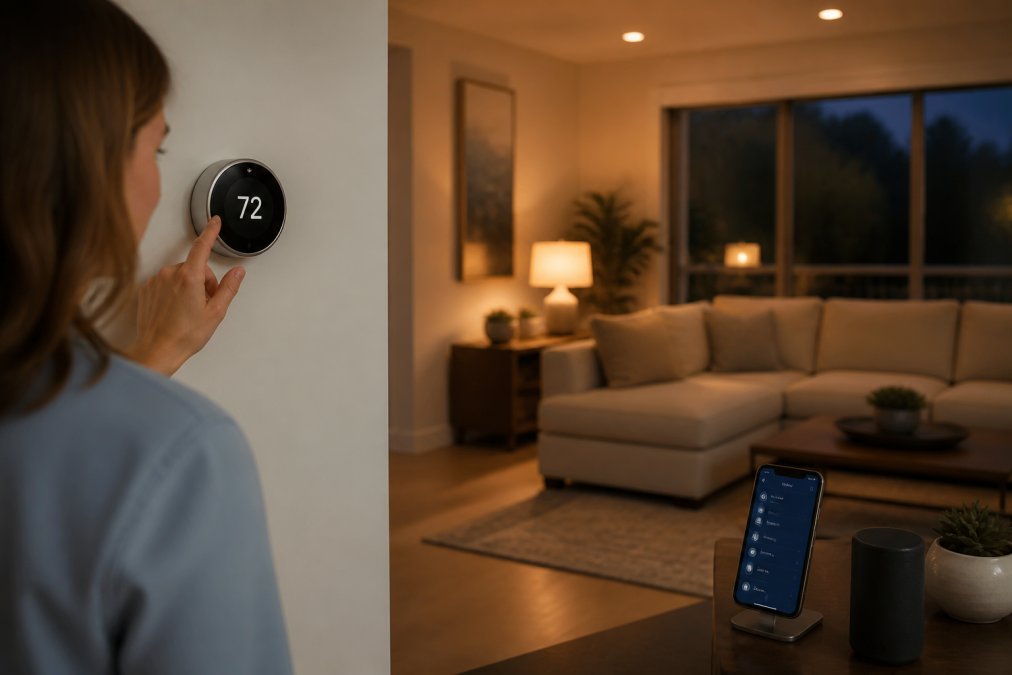
Smart lighting, HVAC integration, and app-based control turn separate systems into one coordinated home. Smart switches replace standard wall switches and connect over Wi-Fi, Zigbee, or Thread, while smart thermostats learn your schedule and adjust HVAC runtime accordingly.
Cybersecurity and Interoperability: What Most Guides Skip
Cybersecurity is the gap in most smart home advice. Every connected device is a potential entry point, and cheap devices shipped with default passwords are the easiest target. The practical hardening steps are not exotic:
- Change default credentials on day one. Default admin passwords are published in device manuals and are the first thing an attacker tries.
- Keep firmware updated. Vendors patch known vulnerabilities; unpatched devices stay exploitable indefinitely.
- Segment the network. Put smart devices on a separate VLAN or guest network so a compromised bulb cannot reach your laptop or NAS.
- Disable unused features. Remote access, UPnP, and cloud accounts you do not use are attack surface you do not need.
- Prefer local control where possible. Devices that work over a local hub without a cloud round-trip keep functioning, and keep your data home, when the vendor’s servers go down.
Retrofitting vs. New Construction
Retrofitting versus new construction changes the calculus here. New builds can run conduit and low-voltage cable during framing, which is far cheaper than opening finished walls later. Retrofits work fine, but plan the network layout before devices arrive, not after. In an older home, the practical sequence is: verify the panel and branch circuits can carry the new load, then plan the wireless topology (where the Thread border router lives, how far the mesh must reach), then buy devices.
Environmental Impact Beyond the Energy Bill
The efficiency story is not only about the monthly bill. Shifting load to off-peak hours, cutting standby draw from idle devices, and trimming HVAC runtime all reduce the carbon intensity of the power the home consumes. A smart electrical system that schedules heavy loads for off-peak windows and eliminates phantom draw lowers the home’s operational footprint even when the rate per kilowatt-hour is unchanged.
Buy for the standard, not the brand. A Matter-certified device from a smaller manufacturer will outlast a proprietary device from a large one that abandons its platform.
Frequently Asked Questions
Do smart home electrical upgrades actually reduce monthly energy consumption?
They can. Smart thermostats, lighting controls, and real-time monitoring help you see where power goes and cut waste. Smart plugs and switches turn off devices that draw power when idle. Savings vary by home size, usage habits, and how many upgrades you install. The biggest gains come from pairing monitoring with automation so the system adjusts without you thinking about it.
Are smart home electrical upgrades compatible with older wiring?
Often yes, but it depends on the wiring condition. Homes with aging panels or ungrounded circuits may need an inspection first. Many smart switches and sensors work on standard wiring, while some devices need a neutral wire. A licensed electrician can confirm what your system supports and whether a partial rewire is needed before adding smart controls.
Does upgrading electrical service increase home value?
A modern, code-compliant electrical system is a selling point, especially for buyers who plan to add EV chargers, solar, or smart devices. Appraisers and inspectors look for adequate service capacity, safe wiring, and updated panels. While no single upgrade guarantees a set dollar increase, a documented, permitted electrical update can make your home more attractive and reduce buyer hesitation during inspection.
What are the primary safety benefits of smart electrical panels?
Smart panels monitor circuits in real time and can flag overloads, overheating, or unusual draw before they become hazards. Some models let you shut off specific circuits remotely, which helps during storms or when a device misbehaves. Combined with whole home surge protection, they add a layer of defense against electrical fires and equipment damage that traditional panels cannot provide.
