


Table of Contents
- Why Professional EV Charger Installation Matters
- Hardwired vs Plug-In EV Charger Installation: Which Is Right for You
- Residential Electrical Panel Upgrade Requirements
- The EV Charger Installation Process: What to Expect
- Understanding EV Charger Installation Cost Factors
- Smart Home Integration and Load Management
- Incentives and Tax Credits for EV Charger Installation
- Choosing a Qualified Electrician for Your Installation
- Frequently Asked Questions
Last Updated: September 21, 2026
Why Professional EV Charger Installation Matters
Installing an electric vehicle charger at home is more complex than plugging in a device. Your home’s electrical infrastructure must support the charging demand, local codes govern the installation, and safety standards exist for good reason. A poorly installed charger can damage your electrical panel, create fire hazards, or fail to function reliably.
Professional installation ensures your system meets all code requirements, integrates safely with your home’s electrical infrastructure, and delivers the charging speed your vehicle needs.
Hardwired vs Plug-In EV Charger Installation: Which Is Right for You
The choice between hardwired and plug-in chargers fundamentally affects your installation complexity, cost, and charging capability. Understanding these two approaches helps you make an informed decision before contacting an installer.
Hardwired Level 2 chargers connect directly to your electrical panel through a dedicated circuit, delivering consistent speeds of 7-19 kilowatts depending on your home’s service capacity. This installation requires running electrical conduit from your panel to the charger location, upgrading your panel if necessary, and obtaining permits. They’re the standard choice for permanent home installations.
Plug-in chargers use a standard 240-volt outlet (like a NEMA 14-50 outlet) and deliver lower power (typically 7.2 kilowatts maximum). They offer flexibility and portability but still require professional installation to meet electrical code.
Residential Electrical Panel Upgrade Requirements
Your electrical panel is the gatekeeper for all power entering your home. Adding a Level 2 EV charger means your panel must have available capacity and a suitable circuit breaker to support the charging load. Understanding your panel’s current state and upgrade triggers helps you anticipate costs and timelines before installation begins.
Assessing Your Current Panel Capacity
Your home’s main service panel is rated by amperage, typically 100, 150, or 200 amps. A Level 2 charger requires a dedicated 40-60 amp circuit breaker and available space in your panel.
First, does your panel have an available breaker slot? Modern 200-amp panels usually have empty slots, but older 100-150-amp panels are often fully populated. If your panel is full, you must upgrade.
Second, does your panel have sufficient amperage headroom? Your electrician performs a load calculation using your utility bills and peak usage patterns to determine whether your existing service can safely support the charger or requires an upgrade.
When Panel Upgrades Are Necessary
Panel upgrades become necessary in three scenarios:
Scenario 1: No available breaker slots. Your panel is full. The solution is a panel upgrade to a higher-capacity panel with more breaker positions.
Scenario 2: Insufficient amperage headroom. Load calculations show that adding a 50-amp charger circuit would exceed your service rating. An upgrade to 200-amp service resolves this.
Scenario 3: Aging panel requiring replacement. Some older panels (Federal Pacific Electric or Zinsco, pre-1990s) have known safety issues and require replacement by code. Your electrician will identify this during assessment.
Panel Upgrade Process and Costs
A panel upgrade involves replacing your main service panel with one rated for higher amperage, typically 200 amps. The process requires utility coordination (1-3 weeks), temporary power disconnection (4-8 hours), licensed electrician work to disconnect and reconnect circuits, and multiple permits with building inspector approval.
Contact Voltedge Electrical for a detailed quote based on your specific situation and home’s electrical infrastructure.
Load Calculation: The Key Decision Point
A qualified electrician performs load calculation following National Electrical Code Article 220 methodology, accounting for continuous loads (chargers), intermittent loads (HVAC, water heater), and demand factors. This determines whether your existing service supports the charger or requires an upgrade.
The EV Charger Installation Process: What to Expect
Professional EV charger installation follows a structured sequence that protects your home and ensures code compliance. Understanding each step removes uncertainty and helps you prepare your property.
Electrical Assessment and Load Calculation
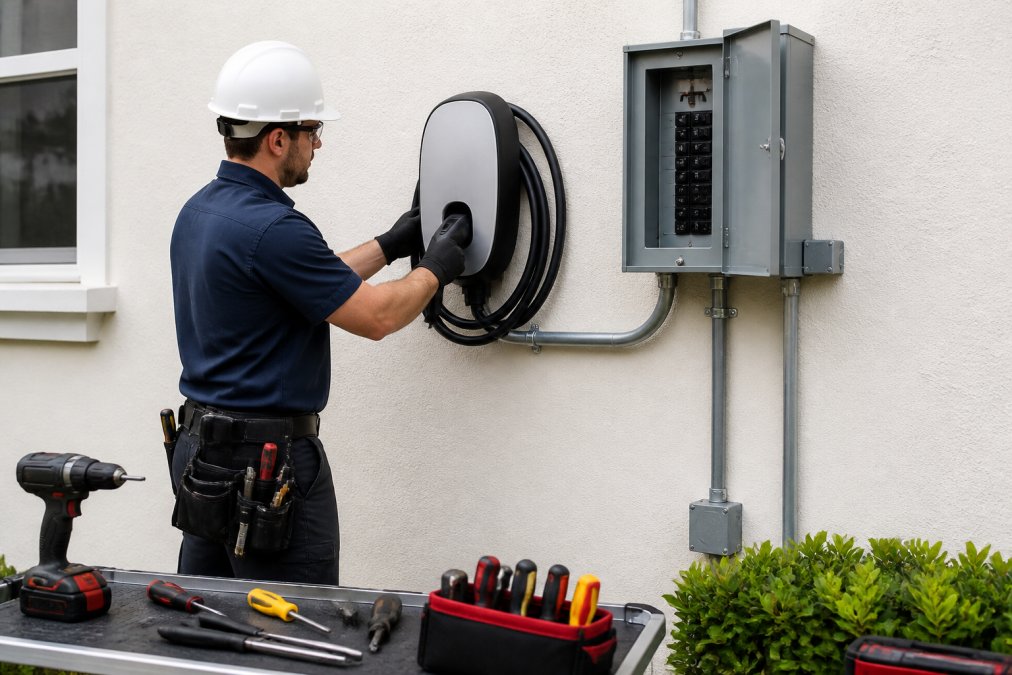
The installation begins with a comprehensive electrical assessment. Your electrician inspects your panel, measures available capacity, identifies the optimal charger location, and calculates amperage requirements. Load calculation determines whether your existing service supports the installation or requires upgrades.
Permitting and Code Compliance
Before installation, permits must be obtained from your local building department to ensure compliance with the National Electrical Code (NEC) and local amendments. Your electrician handles this paperwork. Code compliance specifies circuit breaker types, conduit sizing, grounding requirements, and clearance distances.
Installation and Safety Inspection
Once permits are approved, your electrician runs electrical conduit from the panel to the charger location, installs the dedicated circuit breaker, and connects the charger hardware. The work typically takes one to two days. After installation, your local building inspector performs a final safety inspection before you can use the charger.
Understanding EV Charger Installation Cost Factors
Installation costs vary widely based on factors specific to your home. Understanding these drivers helps you anticipate expenses and evaluate quotes fairly.
Upfront Installation Cost Drivers
Circuit routing complexity directly impacts labor costs. Close proximity to the electrical panel with a clear path is straightforward; running conduit through walls, under concrete, or to detached garages adds 4-8 hours of labor and equipment rental.
Panel capacity and upgrade necessity determine your largest cost component. Contact Voltedge Electrical for a detailed quote based on your specific situation and home’s electrical infrastructure.
Permit and inspection fees vary by jurisdiction. Some municipalities charge flat fees ($50-$150); others base fees on project value or amperage. Your electrician can provide estimates based on your local requirements, and these fees are typically non-negotiable.
Material costs depend on charger type, cable length, and additional components. Smart chargers with Wi-Fi connectivity and load management add $300-$600 but may eliminate the need for an expensive panel upgrade.
Post-Installation Support and Warranty Coverage
The installation cost is only the beginning of your EV charging ownership. Understanding warranty coverage and post-installation support protects your investment if issues arise after the installer leaves.
Charger hardware warranty typically covers the device for 5-10 years but does not cover installation defects or code violations. Installation labor warranty from reputable installers covers 1-5 years, guaranteeing code compliance and reliable function. If issues arise within the warranty period, the installer diagnoses and repairs at no cost.
When evaluating quotes, ask: “What is your labor warranty, and what does it cover?” A qualified installer provides a written warranty document. Installers who decline are a red flag.
Common Post-Installation Issues and Troubleshooting
Charger won’t initiate charging. The most common cause is a communication error. Verify your vehicle recognizes the charger and try unplugging and replugging. If the issue persists, contact your installer.
Charging speed is slower than expected. Check your charger’s display for current power output. If lower than expected, your electrician can verify the circuit is properly sized and configured.
Breaker trips during charging. If it trips immediately, stop using the charger and contact your installer, this suggests a ground fault. If it trips after hours, your home may be drawing more total power than your panel can supply; smart load management can help.
Charger displays error codes. Consult your charger’s manual for specific meanings, and contact your installer if the error persists after a power cycle.
Requesting Transparent Quotes and Warranty Terms
Request itemized estimates breaking down labor, materials, permits, panel upgrades, and warranty coverage. Ask: What is your labor warranty? Will you diagnose and repair malfunctions at no cost? What happens if the charger needs replacement? Do you handle warranty claims with the manufacturer? A professional installer provides clear, written answers.
Smart Home Integration and Load Management
Modern Level 2 chargers offer smart home integration and load management. Load management systems monitor your home’s real-time power consumption and adjust charging speed to prevent overloading your panel. Smart chargers connect to Wi-Fi, allowing you to monitor status, schedule charging during off-peak hours, and set charging limits. These features add cost but may eliminate the need for an expensive panel upgrade.
Incentives and Tax Credits for EV Charger Installation
Federal and state incentives can significantly reduce the net cost of EV charger installation. Understanding what’s available in your area helps you maximize savings.
The federal tax credit for EV charging equipment allows you to claim up to 30 percent of installation costs on your federal income tax return, with a maximum credit of $1,000 for residential installations (Alternative Fuel Vehicle Refueling Property Credit). This applies to both the charger hardware and professional installation labor. You must own your home and install the charger at your primary residence to qualify.
Many states offer additional rebates or tax credits for EV charging installations. Some utilities provide rebates to customers who install Level 2 chargers, treating the infrastructure investment as demand management. These programs vary by location and change annually, so checking your state and utility websites is essential.
Some municipalities offer grant programs or expedited permitting for EV charging installations as part of sustainability initiatives.
Choosing a Qualified Electrician for Your Installation
Your electrician’s qualifications directly determine installation quality and code compliance. Choosing the right professional protects your investment and your home.
Frequently Asked Questions
Do I need a permit for home EV charger installation?
Yes, most jurisdictions require a permit for professional EV charger installation. A licensed electrician handles the permitting process, ensuring your installation meets National Electrical Code (NEC) standards and local building codes. This protects your home’s safety and maintains insurance coverage. Your electrician will coordinate inspections and obtain the necessary approvals before work begins.
What electrical panel upgrades are required for EV chargers?
Your electrical panel must have sufficient capacity to support a Level 2 charger, which typically requires a dedicated 40-60 amp circuit. Older homes with 100-amp panels may need an upgrade to 150 or 200 amps. A professional assessment determines your current capacity and whether upgrades are necessary. Panel upgrades ensure safe charging without overloading your home’s electrical system.
How much does professional EV charger installation cost?
EV charger installation costs vary based on your electrical panel capacity, distance from the panel to the charger location, whether upgrades are needed, and local permitting fees. Contact Voltedge Electrical for a detailed quote based on your specific situation and home’s electrical infrastructure.
Why should I hire a certified electrician instead of a DIY approach?
A licensed electrician ensures your installation meets National Electrical Code standards, obtains required permits, and passes safety inspections. Professional installation protects your home’s electrical system, maintains warranty coverage on your charger, and prevents costly mistakes. Certified installers also navigate local codes and incentive programs, ensuring your system is safe, compliant, and optimized for your needs.
