


Table of Contents
- Why Verifying Electrician Credentials Protects You
- How to Verify Electrician License and Insurance: Step by Step
- How to Verify Electrical Contractor License in Florida
- Licensing vs. Insurance vs. Bonding: What Each One Covers
- How to Request a Certificate of Insurance from a Contractor
- What to Ask an Electrician Before Hiring
- What to Do If a License Is Expired or Invalid
- Frequently Asked Questions
Last Updated: August 28, 2026
Why Verifying Electrician Credentials Protects You
Hiring an unlicensed electrician is one of the most expensive mistakes a homeowner can make. Faulty wiring from unqualified work is a leading cause of residential fires, and when something goes wrong, your homeowner’s insurance policy may deny the claim entirely if the work was performed without proper licensure. That risk alone makes it worth spending 15 minutes to verify electrician license and insurance status before anyone touches your panel.
At Voltedge Electrical, we hear this concern from homeowners regularly: “How do I know you’re actually licensed and insured?” It’s a fair question, and any reputable contractor should welcome it. The verification process is straightforward once you know where to look.
Contractor registration and licensing exist to protect consumers. State regulatory agencies require electricians to pass competency exams, log supervised field hours, and carry specific insurance coverage before they can legally perform electrical work. When you skip verification, you’re bypassing all of that consumer protection infrastructure.
The consequences extend beyond fire risk. An unlicensed worker injured on your property may have grounds to sue you directly. If unpermitted work is discovered during a home sale, you could be required to tear it out and redo it at full cost. These aren’t edge-case scenarios. They happen often enough that due diligence before hiring is non-negotiable.
Below, we’ll walk through exactly how to verify a contractor’s credentials, what each credential actually means, and the specific red flags that should make you walk away.
How to Verify Electrician License and Insurance: Step by Step
Verifying an electrician’s credentials takes four steps. Each one confirms a different layer of protection, and skipping any one of them leaves a gap.
Step 1: Gather the Contractor’s Details
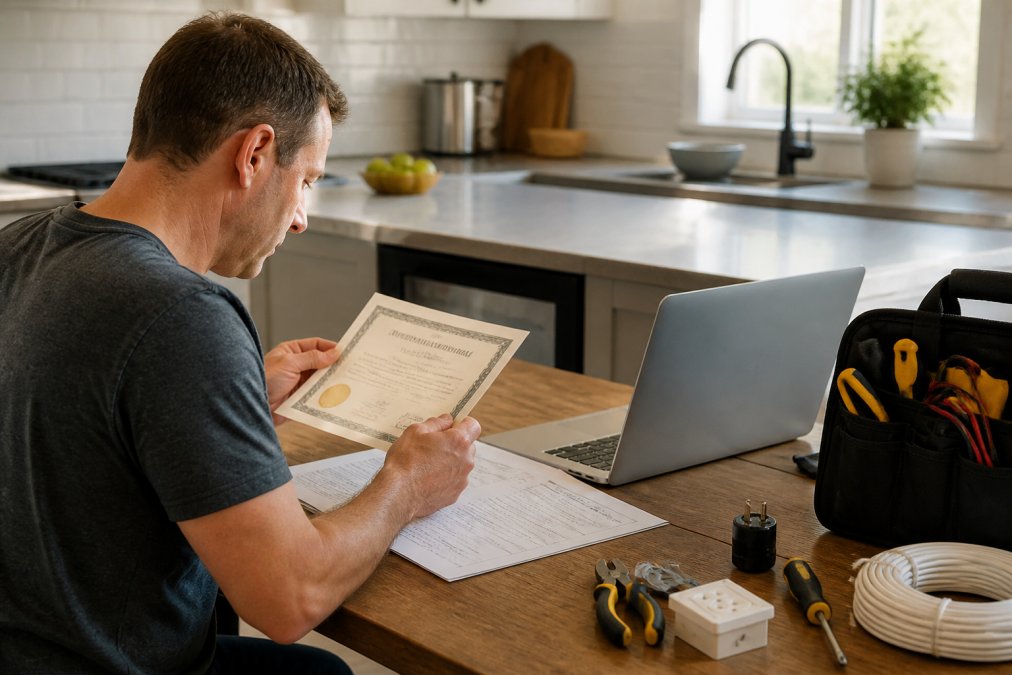
Before you search anything, collect the following from the contractor:
- Full legal business name and any trade name (DBA)
- License number
- State of licensure
- Name of their insurance carrier and policy number
- Contact information for their insurance agent
A legitimate contractor will provide all of this without hesitation. If someone stalls, deflects, or claims they “don’t have it handy,” treat that as your first red flag. Professional tradespeople carry this information as a matter of routine.
Step 2: Search the State Licensing Database by License Number or Name
Every state maintains a public verification portal for licensed contractors. The lookup database is free to use and typically searchable by license number, business name, or individual name.
For most states, the licensing board falls under the Department of Consumer Affairs, the Department of Business and Professional Regulation, or a dedicated contractor licensing division. The National Association of State Contractors Licensing Agencies directory is a reliable starting point to locate your specific state’s regulatory agency.
Enter the license number the contractor provided. Cross-reference the name on the record against the name on any estimate or contract they’ve given you. Discrepancies here warrant a direct question before you proceed.
Step 3: Confirm Active Status and License Type
Finding a license number in the database is not enough. You need to confirm two things: the license is active and paid-to-date, and the license type covers the work you’re hiring for.
Electrical licensing is divided into trade classifications. A journeyman electrician license authorizes work under supervision. A master electrician license authorizes independent work and pulling permits. An electrical contractor license authorizes a business to contract directly with property owners. If you’re hiring someone to upgrade your service panel, you need a contractor holding at minimum a master-level license or equivalent classification in your state.
Also check for any disciplinary action on the record. Most state verification portals display complaint history, license suspensions, and formal violations. A single resolved complaint from years ago is different from a pattern of recent violations.
Step 4: Check Workers’ Compensation Coverage
Workers’ compensation is separate from general liability insurance, and it matters just as much. If an electrician is injured on your property and they don’t carry workers’ comp, you may be liable for their medical bills and lost wages under your state’s labor statutes.
Ask for a certificate of workers’ compensation insurance and verify it through the issuing carrier. Many state workers’ compensation boards also maintain their own lookup tools. The U.S. Department of Labor’s Office of Workers’ Compensation Programs provides guidance on state-level requirements, though the specific verification tool will be your state’s own board.
How to Verify Electrical Contractor License in Florida
To verify electrical contractor license status in Florida specifically, the Florida Department of Business and Professional Regulation (DBPR) operates the primary public lookup tool. Florida’s licensing structure distinguishes between Certified Electrical Contractors, who can work statewide, and Registered Electrical Contractors, who are licensed at the county or municipal level and may not have authority to work outside that jurisdiction.
This distinction matters. A contractor registered in Miami-Dade may not be authorized to perform work in Broward County without separate registration. Always confirm the geographic scope of the license against your property’s location.
The Florida DBPR license verification portal allows searches by name, license number, or business entity. Look for the status field, it should read “Current, Active.” Any other status, including “Delinquent,” “Suspended,” or “Null and Void,” means the contractor cannot legally perform electrical work in Florida.
Florida also requires electrical contractors to carry a minimum level of general liability coverage and workers’ compensation. The specific minimums are set by Florida Statute and enforced through the DBPR. If a contractor’s license record shows expired or missing insurance, they are out of compliance regardless of their technical skill.
A contractor who holds a valid Florida license but whose insurance has lapsed is still operating illegally. The license status and the insurance status are tracked separately, always check both.
Licensing vs. Insurance vs. Bonding: What Each One Covers
Most homeowners treat these three as interchangeable. They are not. Each one protects a different party against a different type of loss.
| Credential | What It Covers | Who It Protects |
|---|---|---|
| License | Legal authority to perform electrical work | Public safety and code compliance |
| General Liability Insurance | Property damage or injury caused by the contractor’s work | The homeowner / property owner |
| Workers’ Compensation | Injuries to the contractor’s employees on your property | The homeowner from labor liability |
| Surety Bond | Incomplete or non-compliant work | The homeowner from contractor default |
Licensing is a regulatory credential. It confirms the contractor has met the state’s minimum competency requirements and is authorized to pull permits. It does not pay for anything if something goes wrong.
General liability is the coverage that pays when a contractor damages your property or a third party is injured as a result of their work. A typical residential electrical project warrants at least $1 million in general liability coverage, though the right amount depends on project scope.
Workers’ compensation covers the contractor’s own employees. Without it, an injured worker may pursue a claim against your homeowner’s policy or sue you directly.
Bonding (surety bond) is a financial guarantee that the contractor will complete the work as agreed. If they abandon the project or fail to meet permit requirements, the bond provides a mechanism for financial recovery. Not all states require bonding for electrical contractors, but its presence signals a higher level of professional accountability.
A common mistake is accepting proof of one and assuming the others are covered. Request documentation for all three.
How to Request a Certificate of Insurance from a Contractor
A certificate of insurance (COI) is a one-page summary document issued by the contractor’s insurance carrier that confirms active coverage. Requesting one is standard practice in any professional contractor relationship, and any contractor who resists providing it should not be hired.
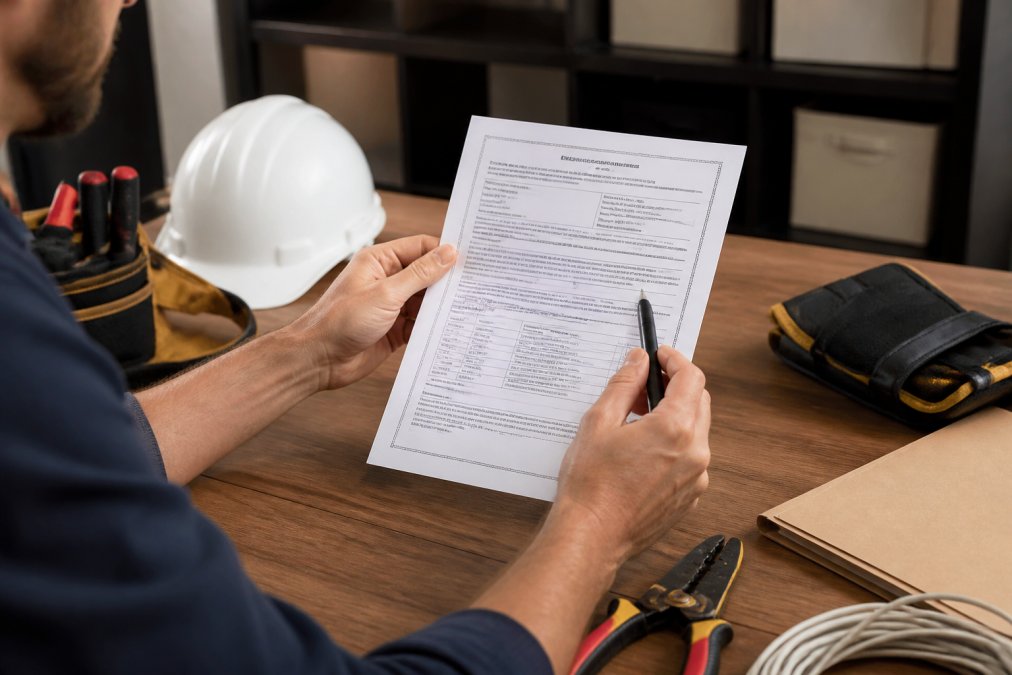
Here’s the exact process:
- Tell the contractor you require a COI before work begins.
- Ask them to have their insurance agent send the COI directly to you, not through the contractor. This prevents document alteration.
- Confirm the document names you (the property owner) as the certificate holder.
- Verify the coverage amounts and policy effective dates.
- Call the insurance carrier listed on the COI to confirm the policy is active.
That last step is the one most homeowners skip. A COI is easy to fabricate or alter. A two-minute phone call to the carrier eliminates that risk entirely.
Red Flags to Watch for on a COI
The COI itself can tell you a lot about whether a contractor is operating professionally. Watch for:
- Expiration dates that have already passed. Coverage that lapsed last month offers you no protection today.
- Coverage amounts that seem unusually low. Bare-minimum policies may not cover the full cost of a serious incident.
- The contractor’s business name doesn’t match what’s on the estimate. This could indicate a different legal entity or an unlicensed subcontractor performing the work.
- No workers’ compensation listed. If the contractor has employees, this is a compliance failure.
- Generic policy language with no specific limits shown. A legitimate COI itemizes coverage types and dollar amounts clearly.
Ask the contractor to list you as an “additional insured” on their general liability policy for the duration of the project. This gives you direct standing to file a claim if something goes wrong, rather than having to go through the contractor first.
What to Ask an Electrician Before Hiring
Knowing what to ask an electrician before hiring separates homeowners who get burned from those who don’t. The following questions are worth asking directly, before you sign anything:
- “Can you provide your license number and the state it’s issued in?” A confident, immediate answer is the baseline expectation.
- “Will you pull the required permits for this work?” Any electrician who suggests skipping permits to save money is offering to create a liability problem for you, not a savings.
- “Who specifically will be performing the work, you, or a subcontractor?” If subcontractors are involved, their credentials need the same verification.
- “Can your insurance agent send the COI directly to me?” This tests both the existence of coverage and the contractor’s willingness to be transparent.
- “Have you done this type of work in homes of this age or construction type?” For older homes with outdated electrical systems, experience with legacy wiring configurations matters.
- “What happens if the project runs into unexpected issues inside the walls?” How a contractor answers this question reveals a lot about their communication style and pricing transparency.
The goal isn’t to interrogate. It’s to confirm that the person you’re about to let into your home operates with the same professionalism you’d expect from any licensed tradesperson.
What to Do If a License Is Expired or Invalid
Finding an expired or invalid license during verification doesn’t automatically mean the contractor is dishonest. Licenses lapse due to missed renewal paperwork, administrative errors, or a gap between license types during a business restructuring. What matters is how the contractor responds when you bring it up.
A legitimate contractor will know about the issue, be able to explain it, and show you documentation of a pending renewal or correction. An unlicensed contractor will usually offer excuses, minimize the concern, or pressure you to proceed anyway.
Here’s what to do:
- Stop the hiring process. Do not sign a contract or pay a deposit until the license status is resolved.
- Contact the state licensing board directly. Ask whether the contractor is authorized to perform work while renewal is pending. Some states allow a grace period; others do not.
- Request written confirmation of active status before work begins. A verbal assurance is not sufficient.
- Check for disciplinary action. An expired license combined with a history of complaints is a pattern, not a coincidence.
- Report unlicensed activity. If you believe a contractor is knowingly operating without a valid license, most state regulatory agencies have a complaint or reporting mechanism. The Florida DBPR unlicensed activity reporting is one example of a state-specific resource.
Unlicensed electrical work creates permit compliance problems that follow the property, not the contractor. If you sell the home, inspectors will find it. If there’s a fire, your insurer will investigate it. The risk stays with you.
Verifying credentials takes 15 minutes. Undoing the legal and financial consequences of skipping that step can take years. The verification process is the most important part of the hiring decision.
Electrical work is not a category where cutting corners on vetting pays off. The combination of safety risk, insurance exposure, and permit compliance makes the credential verification process genuinely consequential. Voltedge Electrical is licensed and insured, and we provide full documentation to every client before a project begins, because we know that’s exactly what a careful homeowner should require. If you’re ready to move forward with a contractor who welcomes scrutiny, reach out to Voltedge Electrical and inquire now.
Frequently Asked Questions
How do I verify an electrician’s license in Florida?
Go to the Florida Department of Business and Professional Regulation (DBPR) online verification portal at myfloridalicense.com. Enter the contractor’s name, business name, or license number to pull up their official record. The result will show their license type, current status, expiration date, and any disciplinary action on file. Always confirm the status reads ‘active and paid-to-date’ before signing any agreement.
What is the difference between a licensed and insured electrician?
A license confirms that an electrician has passed the required trade exams and meets state competency standards set by a regulatory agency. Insurance is separate: it covers financial liability if something goes wrong on the job. General liability insurance protects your property if the electrician causes damage, while workers’ compensation covers their crew if someone is injured on your premises. You need both, a license alone does not protect you from property damage claims or injury lawsuits.
Can I ask an electrician for proof of insurance?
Yes, and you should always ask before work begins. Request a certificate of insurance (COI) directly from the electrician or their office. A legitimate contractor will provide one without hesitation. The COI should list your name or address as the certificate holder, show active general liability and workers’ compensation coverage, and display policy dates that extend through your project. If a contractor refuses or delays producing a COI, treat that as a serious red flag.
What happens if I hire an unlicensed electrician?
Hiring someone engaged in unlicensed activity creates real financial and legal exposure. If unpermitted work causes a fire or injury, your homeowner’s insurance may deny the claim. You could also be held liable for injuries to the worker since they carry no workers’ compensation. Local code enforcement may require you to tear out and redo the work at your own expense. In Florida, performing electrical work without a valid license is a violation under state contractor registration statutes.
This article was written using GrandRanker
