


Table of Contents
- Understanding EV Charger Installation Timeline Basics
- Level 1 vs Level 2 Charger Installation: Timeline Differences
- EV Charger Installation Permit Requirements and Approval Process
- Electrical Panel Upgrade for EV Charger: Impact on Project Duration
- Site Assessment, Planning, and Utility Coordination
- Cost of Level 2 EV Charger Installation and Budget Planning
- Residential vs Commercial Installation Timelines
- Conclusion
- Frequently Asked Questions
Last Updated: September 25, 2026
Understanding EV Charger Installation Timeline Basics
The average EV charger installation timeline ranges from one to four weeks for most residential projects, depending on your electrical setup and local permitting requirements. Permitting and utility coordination typically take longer than the actual installation work.
A straightforward Level 2 charger installation takes 2-3 days of labor, but permit applications, electrical panel upgrades, utility coordination, and inspections extend the total timeline to several weeks. Understanding each phase helps you plan realistically.
Level 1 vs Level 2 Charger Installation: Timeline Differences
Level 1 chargers plug into standard outlets with no installation work. Level 2 chargers require hardwired installation, grounding, and circuit breaker setup, which is why the EV charger installation timeline differs dramatically.
Level 1 chargers:
- Installation time: Same day (just plug in)
- Electrical work needed: None
- Permitting required: No
- Cost and complexity: Minimal
Level 2 chargers:
- Installation time: 1-3 days of labor
- Electrical work needed: Dedicated circuit, conduit, grounding, NEMA 14-50 outlet or hardwired connection
- Permitting required: Yes, in most jurisdictions
- Cost and complexity: Moderate to high
The real difference isn’t the installation day itself, it’s everything that happens before. A Level 2 charger installation timeline includes weeks of permitting, utility coordination, and potential electrical panel upgrades.
EV Charger Installation Permit Requirements and Approval Process
Nearly every municipality requires permits for Level 2 EV charger installation, making this the single biggest driver of timeline delays.
Here’s what the permit approval process typically involves:
Step 1: Submit permit application (1-2 days)
You’ll need site photos, electrical plans, charger specifications, and proof of a licensed electrician.
Step 2: Initial review (3-7 business days)
The local building department checks that your application is complete.
Step 3: Technical review (5-10 business days)
The electrical inspector reviews your plans against local electrical code, load calculations, and utility requirements.
Step 4: Approval and permit issuance (1-3 business days)
Once approved, you receive your permit and can schedule installation.
Step 5: Post-installation inspection (3-7 days to schedule)
An inspector verifies the installation meets code and safety standards before you can use the charger.
The entire EV charger installation permit process typically takes 2-3 weeks, stretching to four weeks in busy jurisdictions. Start the permit process immediately, before hardware arrives.
Electrical Panel Upgrade for EV Charger: Impact on Project Duration
If your home has an older electrical panel or limited available capacity, an electrical panel upgrade becomes necessary. This single factor can double your total EV charger installation timeline.
Most homes built before 2000 have 100-amp or 150-amp service panels. A Level 2 charger needs 40-60 amps of dedicated capacity, requiring a service upgrade to 200 amps if your panel is near capacity. An electrical panel upgrade adds 3-4 weeks to your total project timeline through additional permitting, utility coordination, electrician labor, and inspection. A site assessment early in the process reveals whether you need a panel upgrade.
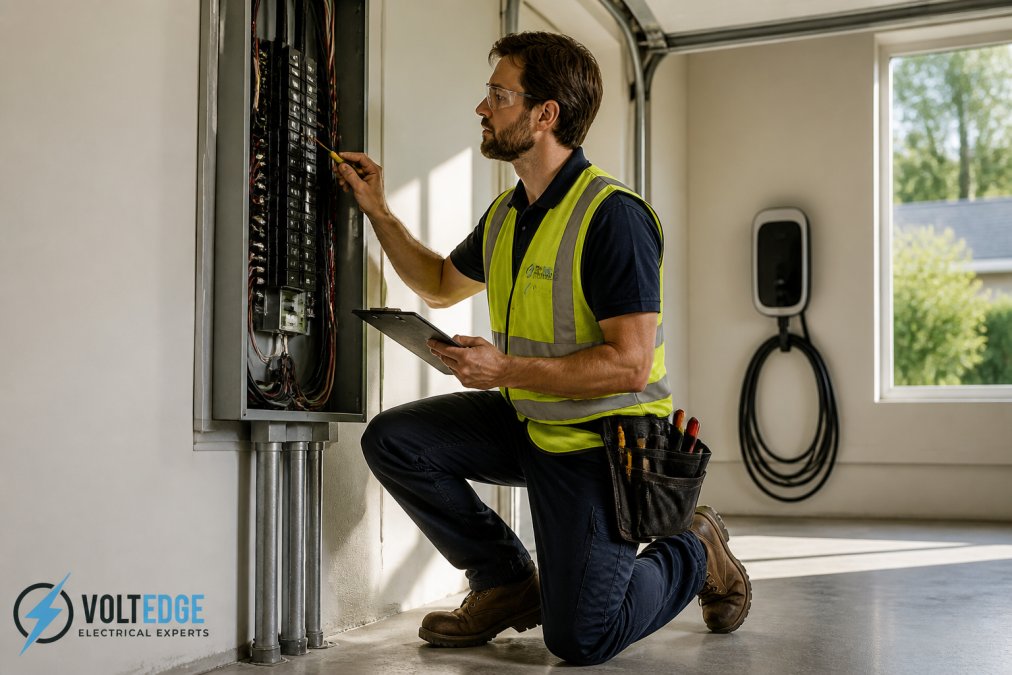
Site Assessment, Planning, and Utility Coordination
A professional site assessment reveals realistic timelines and identifies the most overlooked bottleneck: utility company coordination, which often takes longer than the actual electrical installation work.
Why Utility Coordination Is the Hidden Timeline Killer
Your utility company must verify that your new charger load won’t exceed the capacity of the transformer serving your neighborhood or create imbalances on the grid. This is not a rubber-stamp process. Here’s what typically happens:
Utility intake and assessment (3-7 business days): You submit a service upgrade request. During peak seasons, this can stretch to two weeks.
Load study and feasibility review (5-14 business days): The utility’s engineering team determines if the transformer can handle the additional load.
Approval or upgrade requirements (1-7 business days): The utility either approves your service upgrade or requires transformer upgrades, which can add 4-8 weeks.
Service connection scheduling (3-10 business days): Once approved, the utility schedules a technician to upgrade your meter base or service entrance.
Utility coordination alone can consume 3-4 weeks.
Regional Utility Differences
Utility timelines vary dramatically by region. Areas with modern grid infrastructure and experience with EV charger requests (California, Colorado, New York) often have streamlined processes and faster approval timelines. Rural areas or utilities with less EV experience may have longer review periods or require additional documentation.
Homes Requiring Transformer or Service Upgrades
Transformer upgrades require utility approval (1-2 weeks), crew scheduling (2-4 weeks), physical work (1 day), and inspection (1-3 days), adding 4-8 weeks total. This is rare for single-home Level 2 installations; most modern neighborhoods have sufficient capacity.
Coordinating Utility Work with Electrical Installation
Timing matters. Your licensed electrician cannot energize the new charger circuit until the utility has completed its service upgrade work. This means:
- Submit your utility service upgrade request immediately (week 1)
- Proceed with permit applications and electrical planning in parallel (weeks 1-3)
- Once utility approves the upgrade, schedule the utility technician (weeks 3-4)
- After utility work is complete, your electrician installs and energizes the charger (weeks 4-5)
- Final inspection (week 5-6)
Utility coordination is the single most common cause of installation delays exceeding 4 weeks. Contact your utility company on the same day you contact your electrician for a site assessment. Do not wait for permit approval or hardware delivery to initiate utility coordination.
Cost of Level 2 EV Charger Installation and Budget Planning
Total costs include charger hardware, electrical panel upgrade (if needed), conduit and wiring, permit fees ($50-$300), and licensed electrician labor ($1,500-$3,000 for standard installations). Get a detailed quote from a licensed electrician who can assess your home’s actual needs.
Request your site assessment and quote early. Knowing your actual costs and timeline upfront eliminates stress and lets you plan when to schedule installation around your schedule.
Residential vs Commercial Installation Timelines
EV charger installation timelines vary dramatically by property type. Single-family homes, condos, HOAs, apartments, and commercial properties face different approval processes.
Single-Family Home Installations
Residential installations (single-family homes):
- Typical timeline: 2-4 weeks
- Electrical requirements: Single-phase 240V, 40-60 amps
- Permitting complexity: Standard residential electrical permits
- Utility involvement: Minimal, unless service upgrade needed
- Decision-maker: Homeowner only
Condo and HOA-Governed Properties
Condo owners and residents in HOA-governed communities face an additional approval layer that can extend timelines by 6-8 weeks. HOA boards typically meet monthly, and some require architectural committee review. The HOA may approve, approve with conditions, or deny your request outright. Once HOA approval is secured, you proceed with utility coordination and electrical permits. Total condo/HOA timeline: 6-12 weeks (compared to 2-4 weeks for single-family homes).
Multi-Unit Dwelling (Apartment) Timelines
Renters and apartment dwellers face the most complex approval structure. Charger installation requires landlord approval, property management coordination, and utility company involvement at the building level. Landlords may hesitate or deny requests due to liability concerns or cost responsibility. Older apartment buildings often have limited electrical capacity, making charger installation impossible without major upgrades. Multi-unit buildings require separate metering coordination and building-wide permitting. Total multi-unit dwelling timeline: 8-16 weeks.
Commercial Installations
Commercial installations (4-12 weeks) require three-phase 480V service, 100+ amps, commercial permits, and extensive utility coordination. A single charger may take 6 weeks; 10 chargers could take 3-4 months. Complexity scales with the number of chargers and electrical demands.
Single-family home installations: 2-4 weeks. Condo/HOA properties: 6-12 weeks. Multi-unit dwellings (apartments): 8-16 weeks. Commercial installations: 4-12 weeks. Property type and approval structure are often the largest timeline variables.
If you rent or live in a condo, verify charger installation is permitted and feasible before purchasing an EV. Many buildings prohibit charger installations or lack electrical capacity. Starting the approval process early prevents purchasing an EV only to discover you cannot install a charger at home.
Conclusion
The average timeline for EV charger installation spans 2-4 weeks for most residential homes, but this depends on five key factors: your electrical panel capacity, local permitting timelines, utility coordination needs, whether you need a panel upgrade, and how quickly you move through each phase.
Common Questions About EV Charger Installation Timeline
| Phase | Typical Duration | What Happens |
|---|---|---|
| Site Assessment | 1-2 days | Electrician evaluates panel capacity and installation requirements |
| Permit Application | 1-2 days | Submit paperwork to local building department |
| Permit Approval | 5-15 business days | Building department reviews and approves plans |
| Installation Labor | 1-3 days | Licensed electrician installs charger and wiring |
| Final Inspection | 3-7 days to schedule | Inspector verifies code compliance |
| Total Range | 2-4 weeks | From assessment to approved, ready-to-use charger |
Frequently Asked Questions
How long does the actual EV charger installation process take?
The physical installation of an EV charger typically takes 4 to 8 hours for a Level 2 hardwired system, depending on the complexity of your electrical setup and whether your panel requires upgrades. A simple Level 1 installation using a standard outlet may take just 1 to 2 hours. However, the total project timeline, from initial site assessment through final inspection, usually spans 2 to 8 weeks, primarily due to permitting, inspection scheduling, and any necessary electrical panel modifications or utility service upgrades.
Do I need a permit for home EV charger installation?
Yes, most jurisdictions require permits for hardwired Level 2 EV charger installations. Permits ensure your installation meets electrical code compliance and safety standards set by the National Electrical Code (NEC). The permitting process typically takes 1 to 3 weeks, depending on your local building department’s workload. Your licensed electrician can handle the permit application and coordinate inspections, so you don’t have to navigate the process alone.
What factors cause delays in EV charger installation?
Common delays include electrical panel upgrades (if your current capacity is insufficient), utility company coordination for service upgrades, permit approval wait times, and inspection scheduling. Supply chain delays for charging hardware and EVSE equipment can also extend timelines. Additionally, if your property requires trenching for conduit installation or has complex grounding requirements, the project may take longer. Seasonal labor availability and regional building department backlogs also play a role.
Can a normal electrician install an EV charger?
Yes, any licensed electrician can install an EV charger, provided they understand electrical code compliance, load calculations, and EV-specific safety requirements. However, choosing an electrician experienced with EV charger installations ensures they’re familiar with NEMA 14-50 outlets, hardwired EVSE systems, and the permitting process. An experienced electrician will also identify potential issues, such as electrical panel capacity limits or grounding concerns, before they become costly problems.
