


Table of Contents
- What Affects EV Charger Installation Cost
- Residential Electrical Panel Upgrade Cost Breakdown
- Federal Tax Credit for EV Charging Infrastructure 30C
- EV Charger Installation Timeline and Permitting
- Labor Costs vs. Equipment: Where Your Money Goes
- Retrofitting Older Homes vs. New Construction
- How to Get an Accurate EV Charger Installation Quote
- Frequently Asked Questions
Last Updated: August 30, 2026
What Affects EV Charger Installation Cost
EV charger installation costs range dramatically based on equipment type and location. A Level 1 charger using a standard outlet costs nothing beyond the charger itself, while a DC fast charger requiring a dedicated 200-amp circuit and panel upgrade can exceed $5,000 (energy.gov). Understanding these cost drivers upfront prevents sticker shock.
Homeowners often underestimate electrical infrastructure work. They focus on charger hardware and miss the real cost drivers, panel capacity, distance from the electrical panel, permitting, and labor complexity.
Charger Type: Level 1, Level 2, and DC Fast Charging
Level 1 chargers operate on standard 120-volt outlets and deliver about 3 miles of range per hour. They require no electrical upgrades or installation labor. However, they’re impractical for most EV owners needing meaningful overnight charging.
Level 2 chargers use 240-volt circuits similar to electric dryers and deliver 25-30 miles of range per hour. They represent the sweet spot for residential installations, handling overnight charging efficiently. Level 2 installation requires a dedicated 40-60 amp circuit, proper wiring, and electrical panel assessment, where installation complexity enters the picture.
DC fast chargers operate at 480 volts and deliver 200+ miles of range per hour. They’re commercial-grade equipment designed for public networks, not residential homes. Residential DC fast charging requires complete electrical infrastructure overhaul, specialized installation, and most residential panels cannot support the power draw without full upgrade.
For residential EV charger installation cost calculations, Level 2 is the realistic baseline.
Electrical Infrastructure and Panel Capacity
Your existing electrical panel is the foundation. A modern 200-amp panel with available capacity accommodates a Level 2 charger with minimal work. An older 100-amp panel or one near capacity requires assessment and potentially complete upgrade.
Amperage is critical. Level 2 chargers typically require 40-60 amps of dedicated circuit capacity. If your panel has that available, installation stays straightforward. If not, the electrician must upgrade the main service panel or repurpose circuits safely.
Voltage matters too. Most U.S. residential panels provide 240-volt service for Level 2 chargers. Older homes occasionally have 120-volt-only service, requiring full service upgrade for EV charging capability.
Distance from your electrical panel to the installation location directly impacts wiring costs. A charger 10 feet from the panel requires significantly less conduit and wire than one 50 feet away in a detached garage. Long runs demand larger-gauge wiring, increasing material costs.
Distance from Electrical Panel to Installation Site
Most residential EV chargers install in garages or carports. Adjacent installations are straightforward; opposite-side or detached structures cost significantly more.
The electrician must run conduit from the panel to the installation point, pull wire through it, and ensure code compliance. Every additional 10-20 feet adds material and labor time. Exterior conduit in Florida’s salt-air environment requires corrosion-resistant materials and proper sealing, adding to costs.
Residential Electrical Panel Upgrade Cost Breakdown
Panel upgrades are the biggest cost variable. If your existing panel has capacity, you avoid this entirely. If it doesn’t, expect significant investment.
When You Need a Panel Upgrade
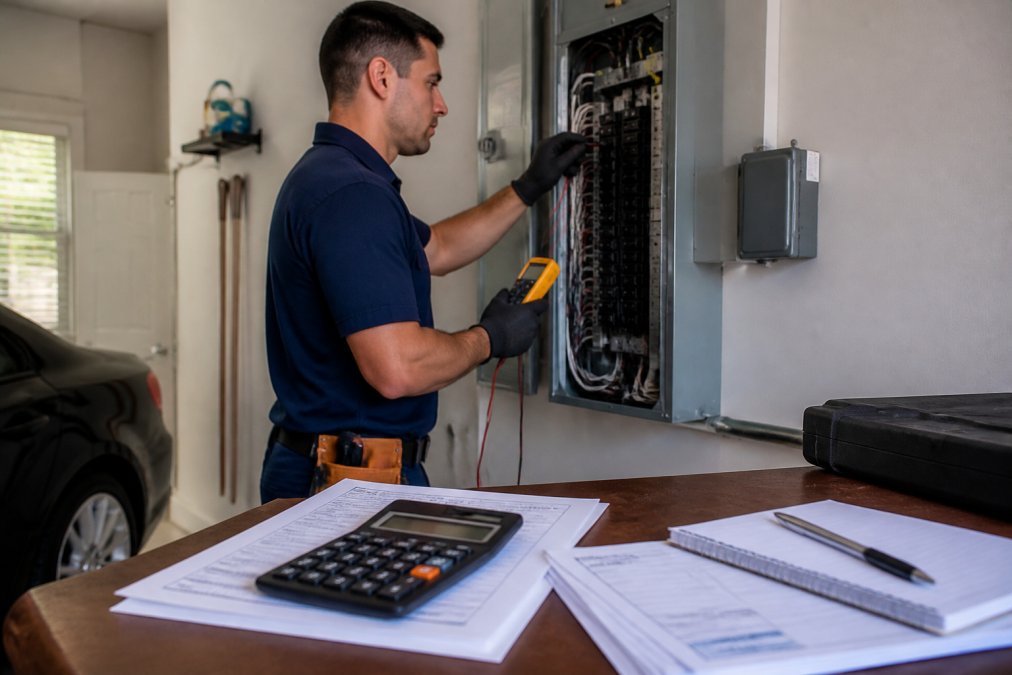
You need a panel upgrade if your current service is 100-amp or lower, if the panel is at or near capacity, or if it’s older design that cannot safely accommodate additional circuits. Homes built before 1980 typically have 100-amp panels. Homes from the 1980s-1990s often have 150-amp panels. Modern homes typically have 200-amp service.
A 100-amp panel cannot support both your home’s existing load and a Level 2 EV charger. Adding a 60-amp circuit to an already-loaded 100-amp panel violates electrical code and creates safety risks. The solution is upgrading to 200-amp service, requiring main service panel replacement, meter upgrade, and utility company coordination.
Load Calculation and Capacity Assessment
A licensed electrician performs a load calculation before any upgrade decision. This assessment adds up all home circuits, estimates simultaneous usage, and determines total amperage needed. A home with electric heat, water heater, and air conditioning draws far more power than one with gas appliances.
The calculation determines whether your existing panel safely accommodates a 40-60 amp EV charger circuit. If existing demand is 100 amps on a 200-amp panel, the charger fits comfortably without upgrades. This assessment prevents oversizing and undersizing, ensuring safety and cost-effectiveness.
Federal Tax Credit for EV Charging Infrastructure 30C
The federal government offers a tax credit for qualified EV charging equipment installations. Section 30C of the Internal Revenue Code provides a credit up to $1,000 for residential charging station installations placed in service during the tax year (irs.gov).
Eligibility Requirements and Application Process
To qualify for the 30C credit, the charging equipment must be new, unused equipment meeting specific performance standards. The charger must deliver at least 7 kilowatts of power for residential use (irs.gov). Installation must occur at your principal residence, second home, or rental property where you own the equipment.
Most Level 2 chargers sold today meet these requirements. Claiming the credit involves filing IRS Form 8911 with your tax return. Keep all receipts and invoices from your electrician. The credit applies to the year the charger is placed in service.
Maximum Credit Amount and Claim Timeline
The maximum credit is $1,000 per charging station. If you install multiple chargers at the same residence, each qualifies separately, up to $1,000 per year. The credit is non-refundable, reducing your tax liability but not generating refunds if liability is lower than the credit amount.
The credit extends through 2032, so 2026 installations qualify. Some states offer additional rebates on top of the federal credit, further reducing net cost.
EV Charger Installation Timeline and Permitting
Installation involves more than electrician labor. Permits, inspections, and utility coordination add time.
Permit Requirements and Inspection Processes
Most jurisdictions require electrical permits for EV charger installations, ensuring code compliance and safety. Your electrician typically handles permit applications.
The permit application includes charger model, circuit specifications, installation location, and panel information. The building department reviews and approves or requests modifications, typically within a few days to a week. Once installation is complete, a municipal electrical inspector verifies code compliance, checking the circuit breaker, wiring gauge, conduit installation, charger mounting, and grounding. Approval closes the permit; issues require correction and re-inspection.
Some utility companies require notification before installation, particularly for significant power draws. This enables load management and may offer off-peak charging incentives.
Typical Installation Duration by Scenario
A straightforward Level 2 installation with no panel upgrades typically takes one to two days. Permitting and inspection add one to two weeks overall.
Panel upgrades extend the project to three to five days of labor, requiring utility coordination to shut off main power, remove the old panel, install the new one, and reconnect service. This adds two to four weeks to the timeline.
Distance from the panel and conduit routing complexity extend labor time. Plan for four to eight weeks total from assessment to completion when panel upgrade is involved. Straightforward installations typically complete in two to three weeks.
Labor Costs vs. Equipment: Where Your Money Goes
Understanding cost allocation helps evaluate quotes and avoid unnecessary expenses.
Licensed Electrician Rates and Installation Complexity
Licensed electrician labor rates vary by region and complexity. Straightforward Level 2 installation with no panel work typically requires 8-12 hours of labor. Panel upgrades add 16-24 hours depending on scope.
Electricians charge either hourly rates or flat fees for specific services. Flat fees are common for standard installations; hourly rates apply when scope is uncertain. A licensed, insured electrician understanding local code and EV charger specifications is worth the investment. Unlicensed contractors expose you to liability, code violations, and safety hazards.
Smart Charger vs. Standard Charger Cost Comparison
Standard Level 2 chargers deliver reliable 240-volt power. Smart chargers add connectivity and programmable features: vehicle communication, rate-based charging adjustment, home energy management integration, and usage monitoring via smartphone apps.
Equipment cost difference is typically $200-400 between standard and smart chargers. Installation labor is identical. Smart chargers make sense with time-of-use electricity rates or solar panel integration. For straightforward charging, standard chargers deliver the same functionality at lower cost.
Retrofitting Older Homes vs. New Construction
Older homes present different challenges than new construction.
Challenges with Outdated Electrical Systems
Homes built before 1990 often have electrical systems designed for lower power consumption. Adding a 50-60 amp EV charger circuit to a system designed for 100-amp total service creates safety concerns.
Older homes may have aluminum wiring requiring special handling and larger-gauge wire. Knob-and-tube wiring, found in pre-1950 homes, is no longer code-compliant and must be replaced. Older panels may lack space for additional breakers without full replacement.
Assessment is more involved in older homes. The electrician must evaluate entire system condition, not just available capacity. Corroded connections, deteriorated insulation, or code violations discovered during assessment may require remediation beyond original scope.
New construction homes typically have modern 200-amp panels with ample capacity and proper wiring. EV charger installation is straightforward because infrastructure was designed with future needs in mind. Builder-installed charging during construction is often cheaper than retrofitting.
Long-Term Maintenance and Repair Costs
A properly installed Level 2 charger requires minimal maintenance. The equipment is solid-state with no moving parts and typically carries a 5-10 year warranty. Occasional connector cleaning and corrosion checking suffice.
An upgraded panel properly sized for your home operates efficiently for decades. A panel running near capacity constantly generates heat and stress, reducing lifespan and increasing failure risk. Smart chargers may require software updates and cloud service subscriptions ($50-100 annually). Standard chargers have no recurring costs beyond electricity.
Significant electrical upgrades beyond the charger circuit improve your home’s overall electrical capacity and resale value.
How to Get an Accurate EV Charger Installation Quote
Getting multiple quotes protects you from overpricing and clarifies what’s included.
What to Ask Your Licensed Electrician
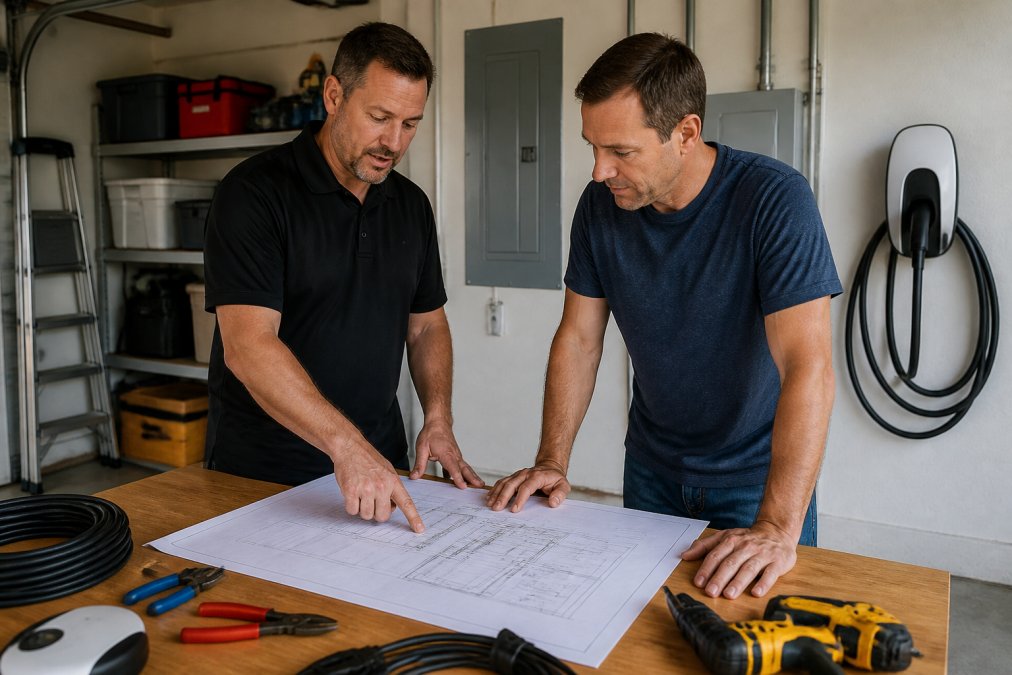
When requesting quotes, provide specific information: home age, current panel amperage, desired charger location, and charger type preference. Ask the electrician to perform a site assessment and load calculation before quoting. A quote based on assumptions is unreliable.
Request itemized quotes separating equipment cost, labor cost, permitting fees, and inspection costs. This breakdown shows exactly where money goes and enables comparison. Confirm the electrician is licensed and insured, and request references from recent EV charger installations. Ask about warranty on installation work and coverage details.
Avoiding Hidden Charges and Surprise Costs
The most common surprise costs come from unanticipated electrical panel upgrades. Insist on site assessment before committing. Confirm whether utility company coordination costs are included.
Ask about contingencies. What happens if code violations are discovered? Are those corrected at additional cost? Get everything in writing. A written quote with scope, timeline, and total cost protects both parties.
| Factor | Impact on Cost | Typical Range |
|---|---|---|
| Charger type | Level 1 minimal, Level 2 moderate, DC fast high | Level 2 most common |
| Panel capacity available | No upgrade needed vs. full upgrade required | Major cost driver |
| Distance from panel | 10 feet vs. 50+ feet significantly different | Labor and material multiplier |
| Permitting timeline | Local jurisdiction variation | 1-4 weeks |
| Smart vs. standard charger | Equipment cost difference | $200-400 |
| Panel upgrade requirement | Complete service replacement if needed | Largest single cost |
EV charger installation cost in 2026 depends almost entirely on your home’s existing electrical infrastructure. A home with modern 200-amp service and a garage near the electrical panel completes installation for modest labor costs. A home with a 100-amp panel and detached garage requires panel upgrade, extended conduit runs, and significant labor. The federal tax credit of up to $1,000 helps offset costs, and proper planning prevents surprises. At Voltedge Electrical, we assess your specific situation, provide transparent quotes, and handle permitting and inspection coordination so you understand exactly what you’re paying for. Contact us for a site assessment and detailed quote tailored to your home’s actual requirements.
Frequently Asked Questions
Is there a federal tax credit for installing an EV charger in 2026?
Yes. The federal tax credit for EV charging infrastructure (Section 30C) allows homeowners to claim up to 30% of installation costs, with a maximum of $1,000 per charger. You must own the residence where the charger is installed, and the charger must be new. The credit applies to both Level 2 and DC fast chargers. Consult a tax professional or visit the IRS website for current eligibility details and documentation requirements for your specific installation.
What factors influence the total cost of EV charger installation?
The main cost drivers are charger type (Level 1 vs. Level 2 vs. DC fast), electrical panel capacity and whether an upgrade is needed, distance from the panel to the installation site, local permitting fees, and labor rates for a licensed electrician. Older homes with outdated electrical systems often face higher costs due to wiring gauge upgrades, conduit installation, and potential panel replacement. Smart charger features and load management systems also add to the total cost.
Do I need a panel upgrade for my home EV charger?
Not always. Most homes with a 200-amp electrical panel can support a Level 2 charger without an upgrade. However, if your home has a 100-amp panel, an older system, or multiple high-demand appliances, you likely need an upgrade. A licensed electrician will perform a load calculation to assess your electrical capacity and determine whether a panel upgrade is necessary. This assessment is a critical first step in planning your installation.
How long does EV charger installation typically take?
A straightforward Level 2 installation with no panel upgrade usually takes 1-3 days once permits are approved. Permitting itself can take 1-4 weeks depending on local requirements and inspection schedules. If a panel upgrade is required, add 2-5 additional days. DC fast charger installations are more complex and may take 5-10 days. Total project duration from quote to operation typically ranges from 4-8 weeks when accounting for permitting, inspection, and installation phases.
How much does it cost to install a 240V outlet for an EV charger?
A dedicated 240V outlet installation (NEMA 14-50 or similar) involves wiring, circuit breaker installation, and conduit work. The cost depends on distance from your electrical panel, local labor rates, and whether your panel has available capacity. If no panel upgrade is needed and the run is short (under 50 feet), costs are generally lower. Longer runs, panel upgrades, or complex wiring scenarios increase expenses significantly. Contact a licensed electrician for an accurate quote based on your home’s specific electrical layout.
What is the difference between a smart charger and a standard EV charger?
A smart charger includes load management, scheduling, and monitoring features that optimize charging based on grid demand and electricity rates. Standard chargers deliver power without these controls. Smart chargers cost more upfront but can reduce electricity costs over time by charging during off-peak hours. They also integrate with home energy management systems. If you have variable electricity rates or want to maximize energy efficiency, a smart charger may provide long-term value despite higher initial installation costs.
What should I expect during the EV charger installation inspection?
A local inspector will verify that the installation meets electrical code, safety standards, and permit requirements. They check wiring gauge compliance, proper grounding, circuit breaker sizing, conduit installation, and the charger’s connection to your electrical panel. The inspection ensures your system can safely handle the amperage and voltage demands. Installations must pass inspection before the charger can be operated. Most inspections take 30 minutes to 1 hour and occur after the electrician completes the work.
Will my older home’s electrical system handle an EV charger?
Older homes with 100-amp panels or outdated wiring may require significant upgrades before EV charger installation is safe and code-compliant. A licensed electrician will assess your panel’s age, capacity, wiring gauge, and overall condition. Many older systems can be upgraded to support charging, but this adds cost and timeline. Modern homes with 200-amp panels typically require minimal upgrades. An electrical inspection is the best first step to understand what your home needs and what costs to expect.
This article was written using GrandRanker
