


Table of Contents
- What Counts as an Electrical Emergency (And What Doesn’t)
- Signs of Electrical Wiring Problems You Should Never Ignore
- What to Do Before Emergency Electrical Repair Arrives
- How to Reset a Tripped Breaker (And When Not To)
- Emergency Electrician Cost: What to Expect and Why
- How to Choose a Licensed Emergency Electrician Near You
- Post-Repair Maintenance: Preventing the Next Emergency
- Frequently Asked Questions
Last Updated: September 17, 2026
What Counts as an Electrical Emergency (And What Doesn’t)
An emergency electrical repair near me is any fault that threatens life, property, or leaves a home without power in a way you cannot safely manage: burning smells, sparking outlets, smoke, buzzing panels, or a breaker that will not reset. Everything else can usually wait for a scheduled visit. At Voltedge Electrical, we take calls from homeowners unsure which category they fall into, and fewer situations are true emergencies than people fear.
True Emergencies: When to Call Immediately
Call right away when you notice any of these:
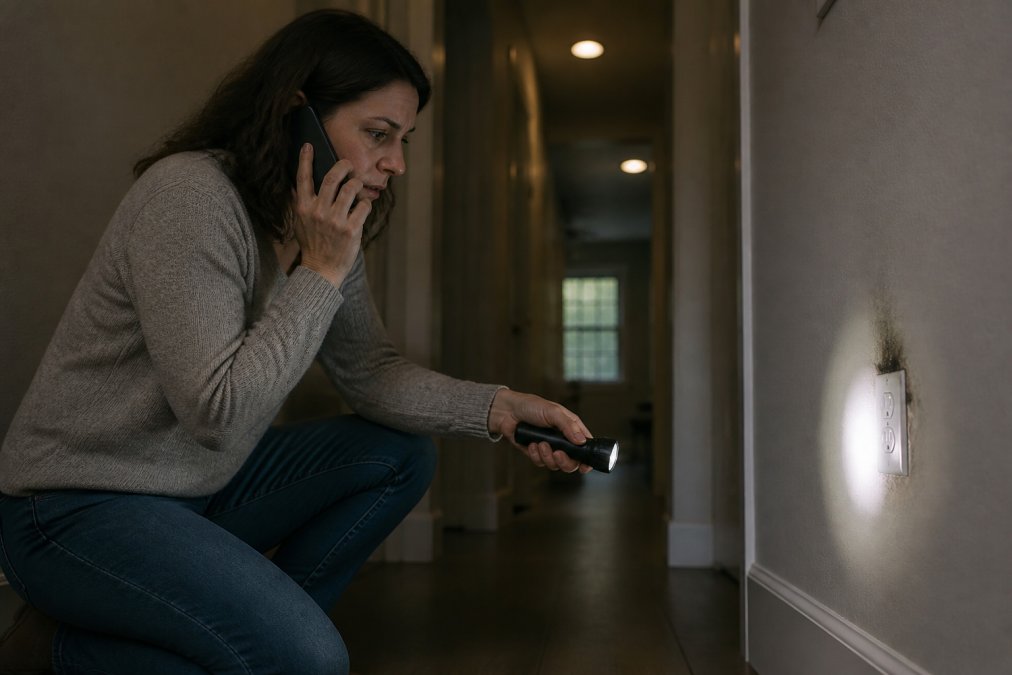
- Smoke, scorch marks, or a burning smell near an outlet, switch, or panel
- Sparking, buzzing, or crackling sounds from wiring or a breaker box
- Water contact with live electrical equipment, such as a flooded outlet or soaked panel
- A downed or exposed power line on your property
- Repeated breaker trips that will not stay reset
- Any shock felt when touching an appliance or fixture
These signals point to an active fault. Waiting turns a repair into a fire risk.
Non-Urgent Issues You Can Schedule
These look alarming but can wait for a weekday appointment:
- A single dead outlet with no burn marks or heat
- A light fixture that flickers only when a specific appliance runs
- A tripped breaker that resets once and stays on
- Dimming lights across the whole house with no smell or sound
- An outdoor outlet or landscape lighting circuit that stopped working
Signs of Electrical Wiring Problems You Should Never Ignore
The warning signs of electrical wiring problems tend to appear long before a failure does. Warm outlets, discolored switch plates, a faint burning odor, and lights that dim when the refrigerator kicks on are all early indicators of a struggling circuit. The U.S. Fire Administration electrical fire safety guidance notes that electrical failures and malfunctions remain a leading cause of home fires, which is why these small signals deserve attention rather than a shrug.
Watch for:
- Outlets or switch plates that feel warm to the touch
- A persistent burning or fishy smell with no visible source
- Lights that flicker when large appliances start
- Breakers that trip more than once a month
- GFCI outlets that will not reset
What to Do Before Emergency Electrical Repair Arrives
While you wait for emergency electrical repair, the priority is distance and disconnection. Keep everyone away from the affected area, avoid touching anything that smells burnt or feels warm, and do not open walls or panels. If there is smoke or visible flame, leave and call 911 first, then your electrician.
DIY Safety Triage: What You Can Safely Do
A few steps are safe for any homeowner:
- Move people and pets away from the area.
- Shut off the breaker for that circuit if you can reach the panel safely.
- Unplug nearby appliances, but never pull a cord that is hot or smoking.
- Keep a phone charged and ready, and clear a path for the electrician.
Do not spray water on anything electrical. Do not reset a breaker that trips instantly. Do not remove an outlet cover to inspect wiring yourself.
Resetting a breaker that trips immediately can arc inside the panel and start a fire. If it trips twice in a row, leave it off and call for help.
How to Reset a Tripped Breaker (And When Not To)
Resetting a tripped breaker is safe only when the cause is a one-time overload and the breaker holds. Below are the mechanics and the cues that mean you should stop and call a licensed electrician.
What a Tripped Breaker Looks Like
Open the panel cover and look at the row of switches. A tripped breaker sits in the middle position, not fully on, not fully off, and some brands show a small red or orange flag. A fully off breaker was switched off manually; a fully on breaker with no power downstream may have failed internally.
The Reset Procedure
- Turn off and unplug the appliances and devices on that circuit. A space heater, a microwave, and a hair dryer on the same circuit is a classic overload.
- Find the tripped breaker in the middle position.
- Push the switch firmly to the full off position. You should feel and hear a click.
- Push the switch firmly to the full on position.
- If it stays on, restore power to the circuit one device at a time and watch for a repeat trip.
GFCI and AFCI Breakers Reset Differently
A GFCI breaker has small TEST and RESET buttons on its face. After a trip, push RESET firmly. If it will not hold, the breaker is sensing a ground fault, often moisture, a damaged cord, or a failing appliance, and should stay off until the cause is found.
When Not to Reset
Do not reset the breaker if any of these are true:
- It trips again within seconds of resetting
- You smell burning or see scorch marks, melted plastic, or discoloration near the panel or the affected outlet
- The panel is warm to the touch, buzzing, or shows rust or water stains
- Water has reached the panel or the affected outlet
- The breaker itself is hot, cracked, or visibly damaged
- You see a downed or exposed conductor anywhere on the circuit
What a Repeat Trip Usually Means
A breaker that trips once and holds is almost always a simple overload, too many high-draw devices on one circuit. A breaker that trips repeatedly points to a short circuit, a ground fault, or a failing breaker that no longer holds its rated current. Each requires tracing the circuit with a meter, a job for a licensed electrician.
If You Are Not Sure, Stop
If you cannot tell whether the breaker is tripped or off, if the panel is old and unlabeled, or if you are uncomfortable opening the panel door, do not proceed. Leave the breaker off, keep everyone away from the affected circuit, and call for emergency electrical repair.
Emergency Electrician Cost: What to Expect and Why
Emergency electrician cost is the question every homeowner asks first. Here is how emergency pricing actually works.
The Three Pricing Models You Will See
- Call-out fee plus hourly. A flat trip charge covers dispatch and the first block of on-site time, then labor is billed hourly. Common for diagnostic-heavy faults.
- Flat-rate by task. A fixed price for a defined job, such as replacing a breaker or GFCI outlet. Predictable, but assumes no surprises behind the wall.
- Time-and-materials. Labor hours plus parts at cost plus markup. Transparent on paper, but the final number is unknown until the work is done.
What Actually Drives the Number
- Time of day and day of week. After-hours, weekend, and holiday calls carry a premium because the company pays overtime or on-call wages.
- Diagnostic difficulty. A fault that trips a breaker the moment it is reset is fast to reproduce. An intermittent fault that only appears when the dryer runs can take an hour or more to isolate.
- Parts. A standard breaker, GFCI receptacle, and length of Romex are inexpensive. A failed main breaker, subpanel replacement, or aluminum branch wiring are not.
- Access. A panel in a finished basement behind drywall costs more to reach than one in an open garage.
- Permits and inspection. Larger repairs, panel changes, and new circuits typically require a permit and inspection, adding a line item.
Questions to Ask Before You Approve Work
- Is there a call-out fee, and does it apply toward the repair if I approve the work?
- Is the quote flat-rate or hourly, and what is the hourly rate after hours?
- What is the diagnostic charge if the fault cannot be found on the first visit?
- Are parts billed at cost plus markup, or included in a flat rate?
- Will you pull the permit, and is the permit fee in the quote?
Ask for the pricing model in writing before the electrician starts. A transparent company will tell you the call-out fee, the diagnostic charge, and whether the repair is flat-rate or hourly.
Why Emergency Work Costs More Than Scheduled Work
A scheduled visit can be routed and staffed during normal hours. An emergency call means pulling a licensed electrician off another job or paying an on-call tech to leave home at 2 a.m. That labor premium is why the same repair costs more at midnight than at noon.
How to Avoid Surprise Charges
- Photograph the panel and affected outlet before the electrician arrives so diagnosis starts faster.
- Write down when the problem happens (time of day, which appliances were running), patterns shorten diagnostic time.
- Confirm whether the quote includes the permit and any drywall repair.
- Ask what happens if the fault is in the utility’s equipment; that work is typically the utility’s responsibility.
A clear quote names the pricing model, the call-out fee, the hourly or flat rate, and what is excluded. If a company will not put that in writing, keep calling.
How to Choose a Licensed Emergency Electrician Near You
The right emergency electrician is licensed, insured, and reachable at any hour. Confirm the license, ask about insurance, and check that the company actually answers the phone at 2 a.m., a live person or rapid callback, not a voicemail box.
Use this checklist before you commit:
- License number verified with your state licensing board
- Proof of insurance and bonding on request
- Live after-hours dispatch, not a message service
- Upfront pricing explained before work starts
- Local service area and reasonable response time
- Willingness to pull permits for larger jobs
| Situation | Action | Why |
|---|---|---|
| Smoke or burning smell | Evacuate, call 911, then an electrician | Fire risk |
| Breaker trips once, resets fine | Reset and monitor | Likely overload |
| Breaker trips twice instantly | Leave off, call for help | Active fault |
| Warm outlet, no smoke | Schedule same-day service | Early wiring problem |
| Downed power line | Stay back, call the utility | Live hazard |
Post-Repair Maintenance: Preventing the Next Emergency
Prevention is cheaper than any emergency call. After a repair, ask what caused the fault and whether other circuits share the same risk, a short circuit in one room often signals aging wiring elsewhere.
A simple maintenance routine goes a long way:
- Test GFCI outlets monthly
- Have the electrical panel inspected periodically, especially in older homes
- Label breakers so you can shut off the right circuit fast
- Avoid overloading outlets with adapters and power strips
- Schedule a whole-house safety inspection after any major repair
Frequently Asked Questions
How do I get an emergency electrician near me?
Search for a licensed electrician with 24/7 emergency electrical repair near you, then call their emergency line directly. Confirm they offer same-day service and have a live dispatcher. Have your address, the nature of the problem, and your panel type ready. If you smell burning or see sparks, leave the area and call 911 first. A reliable provider will give you an estimated arrival time and safety instructions over the phone.
What qualifies as an electrical emergency?
A true electrical emergency includes burning smells, sparking outlets, exposed live wires, a panel that is hot to the touch, or partial power loss affecting medical equipment. A single tripped breaker that resets normally is not an emergency. If you are unsure, err on the side of caution and call a professional. They can help you decide whether same-day service is needed or if it can wait until morning.
How much does an emergency electrician cost?
Emergency electrician cost depends on the time of day, the complexity of the issue, and your location. You should ask for an upfront pricing model before work begins so there are no surprises. Voltedge Electrical offers transparent pricing, so you know what to expect before we start. Contact us for a quote.
How can I safely reset a tripped circuit breaker?
First, unplug appliances on the affected circuit. Locate your breaker panel and find the switch that is in the middle position. Push it firmly to OFF, then flip it to ON. If it trips again immediately, stop and call a licensed electrician. Repeated tripping can indicate faulty wiring or an overloaded circuit. Never force a breaker to stay on, and never reset a breaker while standing in water.
