


Table of Contents
- What Home Buyers Actually Pay for an Electrical Safety Inspection
- What Happens During an Electrical Home Inspection
- Electrical Safety Inspection vs General Home Inspection
- How Much Does Rewiring a House Cost After Inspection Findings
- Red Flags That Increase Your Inspection Cost and Repair Risk
- Using Inspection Results as Negotiation Use
- Frequently Asked Questions
Last Updated: September 26, 2026
What Home Buyers Actually Pay for an Electrical Safety Inspection
The electrical safety inspection cost for home buyers depends on the size, age, and condition of the property, but it is a modest line item next to the purchase price.
Why Pricing Varies by Property Type and Age
Older homes take longer to inspect, and time drives the fee. A 1950s house with original wiring demands far more attention than a 2015 build.
- Square footage: More rooms mean more outlets, switches, and fixtures to test.
- Age and wiring type: Knob-and-tube or aluminum wiring requires closer examination.
- Panel condition: A crowded or mislabeled panel adds time.
- Property type: A single-family home differs from a condo or a multi-unit building.
What Happens During an Electrical Home Inspection
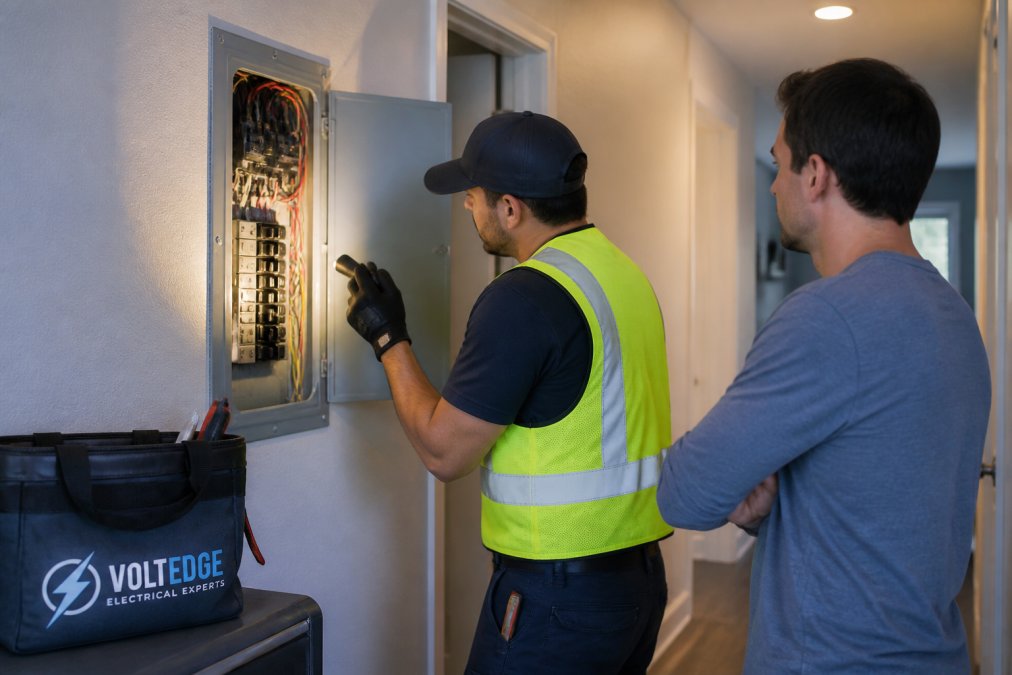
An electrical home inspection is a hands-on evaluation of a home’s electrical system, from the service entrance to the last outlet, performed to identify safety hazards and code compliance issues before a sale closes. The inspector opens the panel, tests outlets and switches, and checks grounding and bonding.
Here is what a thorough inspection covers:
- Service entrance and main panel: Amperage, breaker condition, and labeling
- Wiring condition: Type, age, and visible damage
- GFCI and AFCI protection: Testing where required
- Grounding and bonding: Verifying safe fault paths
- Outlets and switches: Checking for heat, looseness, and reverse polarity
- Load calculation: Confirming the panel can handle the home’s demand
The 4-Point Inspection and Why Insurers Ask for It
A 4-point inspection reviews four systems: roof, HVAC, plumbing, and electrical. Insurers request it on older homes before issuing or renewing a policy. The electrical portion checks the panel, wiring type, and system integrity, a clean report can be the difference between coverage and denial.
Electrical Safety Inspection vs General Home Inspection
An electrical safety inspection vs general home inspection is not a competition. They serve different purposes, and smart buyers get both.
| Feature | General Home Inspection | Electrical Safety Inspection |
|---|---|---|
| Scope | Whole house, visual | Electrical system, detailed |
| Performed by | General inspector | Licensed electrician |
| Panel opened | Sometimes | Always |
| Load calculation | Rarely | Yes |
| Repair estimates | General notes | Specific scope |
| Best for | Overall condition | Electrical safety and insurance |
How Much Does Rewiring a House Cost After Inspection Findings
How much does rewiring house cost is the question that keeps buyers up at night, and the honest answer is that it depends on the home. Full rewires are among the most expensive electrical projects a homeowner can face, swinging widely based on square footage, wall access, and wiring type.
Cost drivers include:
- Home size: Larger homes mean more circuits and more labor.
- Wall and ceiling access: Finished walls require patching and repair.
- Wiring type: Removing knob-and-tube or aluminum wiring takes extra care.
- Permits and inspections: Required in most jurisdictions before and after the work.
- Panel upgrades: Often needed alongside a rewire.
Red Flags That Increase Your Inspection Cost and Repair Risk
Certain findings turn a routine inspection into a major repair project, and some turn a financeable home into an uninsurable one. Knowing them before you make an offer gives you leverage.
What to Look For by Decade of Construction
Electrical risk clusters by era, because code requirements and common materials changed over time.
- Pre-1950s homes: Knob-and-tube wiring is the headline risk. It lacks a grounding conductor, the insulation becomes brittle with heat and age, and it is a known fire hazard. Insurance carriers frequently refuse to write new policies on homes with active knob-and-tube, or they require a full replacement before binding. Also watch for 60-amp services that have never been upgraded.
- 1950s through 1970s homes: Aluminum branch-circuit wiring appears in some homes from the mid-1960s into the 1970s. Aluminum expands and contracts differently than copper, loosens at connections, and can overheat. It is insurable in many cases, but often only after a licensed electrician inspects and remediates the connections with approved connectors or pigtails. Federal Pacific Stab-Lok and Zinsco panels from this era are widely flagged by inspectors and insurers for breaker failure history.
- 1980s and 1990s homes: These generally have copper wiring and adequate service, but they predate widespread AFCI requirements and often lack GFCI protection in kitchens, baths, garages, and exteriors. The risk here is usually code-compliance and safety upgrades rather than a full rewire.
- 2000s and newer homes: Modern panels and grounded wiring are the norm, but watch for aluminum feeder conductors on range and HVAC circuits, undersized 100-amp services in larger homes, and DIY additions, finished basements, garage subpanels, EV chargers, that were never permitted. Unpermitted work is the most common problem in newer homes.
The Findings That Affect Insurance Eligibility
This is the part most buyers learn too late: insurance carriers do not just price risk, they decline it. A 4-point inspection on an older home is the carrier’s tool for deciding whether to write the policy.
- Knob-and-tube wiring: Commonly results in a coverage denial or a requirement to replace before binding.
- Aluminum branch wiring: Often insurable after documented remediation; sometimes surcharged.
- Federal Pacific or Zinsco panels: Frequently flagged for replacement before a policy is issued.
- A 60-amp or 100-amp service with modern loads: May trigger a requirement for a service upgrade.
- Double-tapped breakers and unpermitted DIY work: Read as evidence of unpermitted work and can slow or block underwriting.
A Buyer’s Walk-Through Checklist
You do not need to open a panel to spot trouble. Before you pay for a professional inspection, walk the home and look for:
- Panel: Look for rust, scorch marks, a missing cover, or a brand name you can read from the label. Federal Pacific and Zinsco are the two names to recognize.
- Outlets: Two-prong outlets throughout an older home suggest ungrounded wiring. Outlets that feel warm, look discolored, or hold a plug loosely are warning signs.
- GFCI: Look for the test and reset buttons near kitchen and bathroom sinks, in garages, and on exterior outlets. Their absence in an older home is common and correctable.
- Wiring visible in the basement or attic: Cloth-insulated or knob-and-tube wiring is visible without tools. Aluminum wiring is dull silver rather than copper-colored.
- Signs of DIY work: Extension cords used as permanent wiring, junction boxes without covers, and new outlets in old walls that do not match the surrounding finish.
- Service drop and meter: A small service mast or a meter base that looks original to a mid-century home often means the service was never upgraded.
A 100-amp panel is not automatically a dealbreaker, but pairing it with an EV charger, a heat pump, or a finished basement often pushes it past capacity. Buyers who ignore this find out during the load calculation, not before closing, and by then the negotiation window may be closed.
What These Findings Do to Your Repair Budget
The inspection fee is fixed and modest. The repair cost is not. A single failed GFCI is a small line item, but a panel replacement, a partial rewire, or a full rewire of a knob-and-tube home are projects measured in thousands, often requiring permits and a re-inspection. Treat the inspection report as a repair estimate in disguise: every red flag is a number you can negotiate down or budget for.
Using Inspection Results as Negotiation Use
Inspection findings are negotiating tools, not just repair lists. A documented electrical defect gives a buyer a credible reason to ask for a credit, price reduction, or seller-funded repair. What separates a concession from a polite no is the paperwork behind the ask.
Why Specificity Wins the Negotiation
The strongest position comes from a report naming the exact hazard, the code it violates, and the estimated repair cost. “Electrical issues noted” gets ignored. “Double-tapped 20-amp breaker feeding two kitchen circuits, no GFCI protection within six feet of the sink, estimated $650 to correct” gets a response.
The Three Paths and What Each Actually Costs You
- Seller credit at closing. The credit reduces your cash needed at closing and you handle the repair after move-in. This is usually the cleanest path because it does not delay closing. The trade-off: your lender may cap seller credits based on loan type and down payment, so confirm the maximum with your loan officer first.
- Seller-funded repair before closing. The seller hires and pays a licensed electrician, and you get a re-inspection. This is the strongest outcome on paper, but it depends on the seller choosing a qualified contractor rather than the cheapest bid. Ask for the invoice and permit record before releasing the contingency.
- Price reduction. A permanent reduction lowers your purchase price, which lowers your loan amount and your monthly payment. It is the right ask when the defect is structural to the home’s wiring rather than a single failed outlet.
A fourth path that buyers overlook: split the difference. If the seller resists a full credit, ask for half the repair cost as a credit and absorb the rest. This closes deals that would otherwise stall over a few hundred dollars.
Timing, Contingencies, and the Appraisal Problem
Your inspection contingency period is the window for all of this. Once you release the contingency, you lose the leverage, so do not sign until the credit is in writing and reflected in an amended contract or addendum.
Get the electrician’s itemized repair estimate before you make any ask. A number with a scope behind it moves a seller faster than a general complaint, and it gives your agent something concrete to put in the addendum.
When to Walk Away
Some findings are severe enough to change the deal: a Federal Pacific or Zinsco panel with a known failure history, aluminum branch-circuit wiring throughout the home with no remediation, or a service that cannot be upgraded without trenching and utility coordination. If the seller will not credit and you cannot absorb the cost, walking is legitimate, and cheaper than discovering the problem after closing.
Frequently Asked Questions
How much do electricians charge to inspect a house?
Pricing depends on the size of the home, the age of the electrical system, and the scope of the inspection. A basic electrical safety inspection covers the panel, outlets, wiring condition, and grounding. A 4-point inspection for insurance purposes costs less than a full evaluation. Contact a licensed electrician for a quote based on your property.
Do you have to pay for an electrical inspection separately from a general home inspection?
Yes. A general home inspection covers the whole house but only does a visual check of the electrical system. A dedicated electrical safety inspection is performed by a licensed electrician who opens the panel, tests outlets and GFCIs, and evaluates wiring condition. These are separate services with separate fees, and the electrical inspection gives you far more detail on system integrity.
Are electrical inspections required for home insurance?
Many insurers require a 4-point inspection before issuing or renewing a policy on an older home. The inspection confirms the panel type, wiring material, and grounding are acceptable. Homes with knob-and-tube wiring, aluminum wiring, or a 100-amp panel may face coverage restrictions. Ask your insurer what they require before your policy renewal date.
What does an electrical safety inspection cover for a new home buyer?
An electrical safety inspection reviews the service entrance, main panel and circuit breakers, grounding and bonding, GFCI and AFCI protection, outlets and switches, and visible wiring condition. The inspector checks for code compliance and safety hazards like double-tapped breakers or missing cover plates. You receive a written report with findings and repair estimates you can use during negotiation.
An electrical inspection is only useful if you act on what it finds. Whether the report calls for a panel upgrade, a partial rewire, or a simple GFCI fix, the next step is hiring someone who shows up, explains the work in plain language, and stands behind it. Voltedge Electrical offers licensed and insured electricians, 24/7 emergency support, and transparent, itemized quotes for every job. Get started with Voltedge Electrical and turn your inspection findings into a safer, code-compliant home.
