


Table of Contents
- Why Electrical Panel Safety Starts With Understanding Your System
- NEC Electrical Panel Clearance Requirements Every Homeowner Should Know
- How to Identify Signs of an Outdated Electrical Panel
- Essential Safety Gear and Hazard Assessment Before You Touch Anything
- Emergency Shut-Off and What to Do When a Breaker Trips
- Electrical Panel Upgrade Cost: Budgeting for a Safer Home
- Routine Maintenance, Inspections, and Smart Panel Upgrades
- Conclusion: Your Action Plan for a Code-Compliant, Safer Panel
- Frequently Asked Questions
Last Updated: September 9, 2026
Your home’s electrical panel is the single most important safety device you own, yet most homeowners never think about it until a breaker trips. Electrical panel safety for homes isn’t just about knowing where the panel is; it’s about understanding how it protects your family from fire and shock hazards every single day. Our team of licensed and insured electricians helps homeowners across Southern Florida achieve peace of mind. This guide walks you through code requirements and recognizing when it’s time for an upgrade.
Why Electrical Panel Safety Starts With Understanding Your System
Electrical panel safety begins with knowing what you’re looking at. The service panel, often called a breaker box, is the distribution point that receives power from the utility and routes it through individual circuit breakers to different areas of your home. Each circuit breaker is a safety switch designed to cut power automatically when it detects an overload, a short circuit, or a ground fault, preventing wires from overheating and starting a fire.
A common mistake is treating the panel as a mysterious black box. Understanding the basic components, the main breaker, the bus bars, and the individual branch breakers, helps you respond correctly in an emergency. Knowing which breaker controls which room is the first step toward confident, safe interaction with your system.
NEC Electrical Panel Clearance Requirements Every Homeowner Should Know
The National Electrical Code (NEC) sets the standard for safe electrical installation, and its clearance requirements exist to protect anyone who needs to access the panel in an emergency. According to the National Fire Protection Association’s NEC guidelines, the working space in front of a panel must be at least 30 inches wide and 36 inches deep, with a clear height of 6.5 feet from the floor. This space must remain unobstructed, meaning you cannot store boxes, furniture, or other items within that zone.
The reasoning is straightforward: a firefighter or electrician needs immediate, unobstructed access to shut off power quickly. If your panel is behind a door that swings into it, or if storage has encroached on that 36-inch clearance, you’re creating a hazard that could delay an emergency response. Correcting this is one of the simplest, most effective safety improvements you can make.
Storing items in front of your electrical panel is more than an inconvenience; it’s a direct violation of NEC code and a serious fire hazard. In an emergency, every second counts, and a blocked panel can prevent you or a first responder from cutting power to a burning circuit.
How to Identify Signs of an Outdated Electrical Panel
Recognizing the signs of an outdated electrical panel is a critical skill for any homeowner, especially those in older homes. Flickering lights, breakers that trip frequently, and a burning smell near the panel are all red flags that your system is struggling to handle the electrical load. A panel that feels warm to the touch or makes a buzzing or crackling sound indicates loose connections or arcing, which are immediate fire hazards that require professional attention.
Beyond these operational symptoms, physical signs of aging are equally telling. Look for rust or corrosion on the panel box, which suggests moisture intrusion, and check for scorching or discoloration on the breakers or the panel cover. If your home still has a 100-amp service, it’s likely undersized for modern demands like air conditioning, electric vehicles, and multiple high-wattage appliances.
Obsolete Panel Brands to Recognize
Certain panel brands manufactured decades ago have known safety defects and should be replaced immediately. Federal Pacific Electric (FPE) panels, commonly installed between the 1950s and 1980s, are notorious for breakers that fail to trip, creating a severe fire risk (cpsc.gov). Similarly, Zinsco panels, popular in the 1970s, have a history of breakers that weld themselves to the bus bar, making it impossible to shut off power. If you open your panel cover and see either of these brand names, treat it as a critical finding.
If your panel is a Federal Pacific or Zinsco model, do not wait for a problem to occur. These units have documented failure rates that make them a significant fire hazard, and replacement is the only safe option.
Visual Identification Guide for Hazardous Panels
Beyond the two most infamous brands, several other panel characteristics signal an immediate need for professional evaluation. The following visual cues are often missed by homeowners but are instantly recognizable to a trained electrician.
Pushmatic Panels: Manufactured by Bulldog Electric, these panels use push-button breakers instead of toggle switches. Popular from the 1950s through the 1970s, their breakers are known to become stiff and fail to trip, and replacement breakers have been out of production for decades. The panel cover typically has a metallic, brushed finish with a row of rectangular push buttons.
Split-Bus Panels: Common in homes built between the 1950s and 1970s, these panels have no single main breaker that shuts off all power. Instead, they feature a top section with two to four large breakers and a lower section for lighting and outlets. To shut off all power, you must flip up to six breakers, a dangerous delay in an emergency. A key visual cue is the absence of one large, clearly marked ‘MAIN’ breaker at the top.
Aluminum Wiring Connections: While not a panel brand, if your panel’s branch circuit wires are silver-colored rather than copper, you likely have aluminum wiring, common in the 1960s and 1970s. Aluminum expands and contracts at a different rate than copper, causing connections to loosen over time and creating a serious fire risk. This requires special anti-oxidant compounds and rated connectors, a job for a professional.
Signs of Over-fusing: Check the amperage rating printed on the breaker handle against the wire gauge connected to it. A 20-amp breaker connected to 14-gauge wire (rated for 15 amps) is a code violation and a fire hazard. If you see a 20-amp breaker where a 15-amp was originally, or wiring that looks like a bird’s nest with multiple wires under a single screw, you have an over-fused circuit that needs immediate correction.
Scorching and Discoloration: Look closely at the plastic casings of the breakers themselves. Any yellowing, browning, or melting of the plastic is a sign of prolonged heat exposure from a loose connection. A white or gray powdery residue on the metal bus bars or breaker terminals indicates corrosion, which increases resistance and generates heat.
If you identify any of these visual markers, an unfamiliar brand name, a push-button design, a lack of a single main breaker, or signs of heat damage, your next step is not to test the panel but to schedule a professional inspection. A licensed electrician can confirm the hazard and provide a plan for remediation, which in most cases will involve a full panel replacement.
Essential Safety Gear and Hazard Assessment Before You Touch Anything
Before you even think about opening your panel cover, you need the right protective equipment and a clear hazard assessment. Electrical panel safety for homes requires treating the panel with respect, as the incoming service lugs at the top of the panel are always live, even when the main breaker is off. Essential personal protective equipment (PPE) includes insulated rubber gloves rated for electrical work, safety goggles to protect against arc flash, and non-conductive footwear.
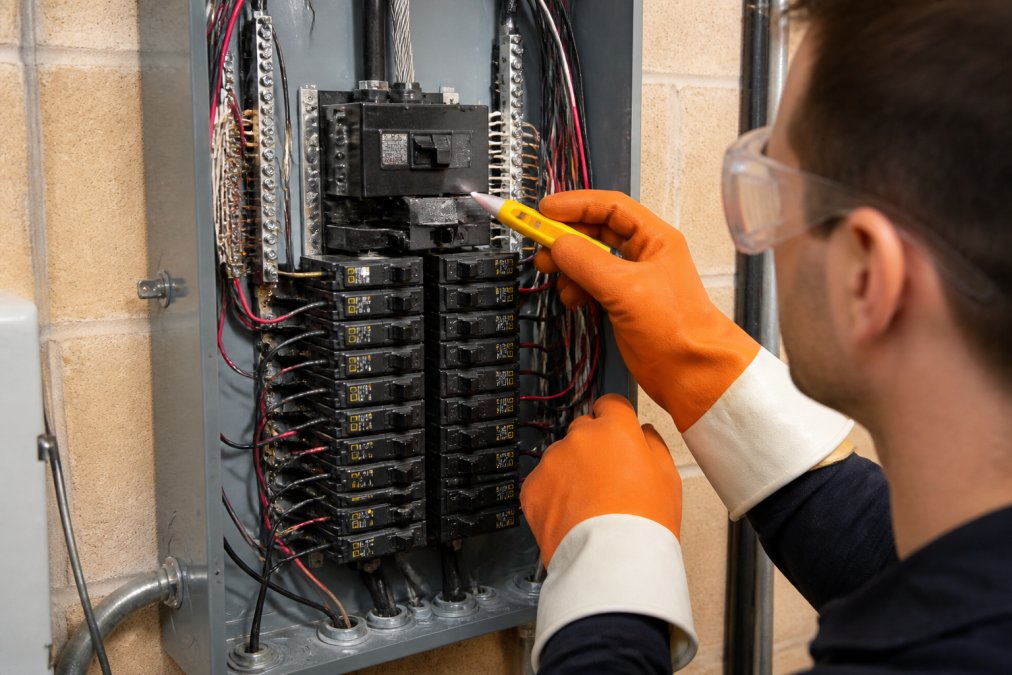
Your hazard assessment should start with a visual inspection. Look for any signs of water intrusion, which is an immediate danger, and never attempt to work on a wet panel. Check the condition of the wires entering the panel; if you see frayed insulation or exposed copper, stop and call a professional. A simple non-contact voltage tester confirms whether a circuit is truly dead before you touch any component.
Emergency Shut-Off and What to Do When a Breaker Trips
Knowing how to perform an emergency shut-off is the most critical piece of electrical panel safety knowledge you can have. In the event of a fire, a burning smell, or a tingling sensation from an appliance, the first action is to shut off the main breaker. This cuts all power to the house and eliminates the source of the hazard. If you cannot safely reach the panel or if the panel itself is smoking, evacuate the home and call 911 from a safe location.
A tripped breaker is a more common and less dramatic event. When a breaker trips, it moves to a middle position between “on” and “off.” To reset it, push it firmly to the “off” position, then flip it back to “on.” If the breaker trips again immediately, do not keep resetting it; this indicates a persistent overload or short circuit that needs professional diagnosis. Frequent tripping on a single circuit usually means too many devices are drawing power, and the solution is to redistribute the load or add a new circuit.
Electrical Panel Upgrade Cost: Budgeting for a Safer Home
Electrical panel upgrade cost is often the biggest concern for homeowners, and for good reason. While the investment can seem significant, it is a direct investment in the safety and value of your home. The total cost depends on several factors, including the amperage of the new panel, the complexity of the installation, and whether your current wiring needs updates to meet modern code. Because every home is different, the most accurate way to budget is to get a detailed quote from a licensed electrician who can assess your specific needs.
Pricing varies widely based on your location and the scope of work, so consult a professional for current estimates. What you’re paying for is not just the hardware, but the expertise to ensure the installation is done safely and passes inspection. An upgrade from a 100-amp to a 200-amp service provides capacity for modern appliances, EV chargers, and future additions, and it often reduces the risk of electrical fires, which can lower your homeowners insurance premiums.
Routine Maintenance, Inspections, and Smart Panel Upgrades
Routine maintenance is the key to extending the life of your electrical panel and preventing unexpected failures. At least once a year, you should visually inspect the panel for signs of rust, pests, or loose breakers, and test your GFCI and AFCI breakers by pressing their “test” buttons. These devices are designed to protect against ground faults and arc faults, respectively, and they should trip immediately when tested. If they don’t, they need to be replaced.
A Practical Homeowner Maintenance Checklist
A simple visual inspection can catch many problems before they escalate. Here is a step-by-step checklist you can perform safely without removing the panel cover:
- Check the panel exterior: Look for rust, dents, or signs of water staining on the metal box. If the panel is outdoors, ensure the door seal is intact and the enclosure is weathertight.
- Listen for unusual sounds: Stand near the panel and listen for a steady buzz or crackle. A low hum from the transformer is normal, but a crackling or sizzling sound indicates arcing and requires immediate professional attention.
- Smell for burning odors: Any acrid or fishy smell near the panel is a sign of overheating insulation or melting components. If you detect this, call an electrician immediately and consider shutting off the main breaker if it is safe to do so.
- Verify the panel is cool to the touch: Place the back of your hand on the panel cover. It should be at room temperature. A warm or hot panel indicates an overloaded circuit or a loose connection inside.
- Test GFCI and AFCI breakers: Press the “test” button on each breaker. The breaker should immediately trip to the “off” or middle position. If it does not trip, the breaker is defective and must be replaced. Reset the breaker by pushing it fully to “off” and then back to “on.”
- Confirm your panel’s clearance is clear: Re-check that the 30-inch width and 36-inch depth clearance in front of the panel is free of stored items, furniture, or debris.
Never remove the dead front cover of your panel for a DIY inspection. The service lugs and bus bars behind it are always energized, even with the main breaker off. A professional inspection is the only way to safely check the internal connections and torque of the breakers.
Smart Panel Integration: A New Layer of Safety
For homeowners looking to modernize, smart panel technology offers a new level of monitoring and control that goes beyond what a traditional panel can provide. Smart breakers, such as those from Span, Leviton, and Schneider Electric, replace standard breakers and connect to a home Wi-Fi network. They provide real-time data on energy consumption for each circuit, which is a powerful safety tool.
The safety benefits are concrete. Smart breakers can detect abnormal energy signatures that precede a failure, such as a slowly increasing current draw on a circuit that indicates a failing appliance motor. They can send an alert to your smartphone the moment a breaker trips, so you know about a problem even when you are away from home. More advanced systems allow you to shut off individual circuits remotely, preventing a minor issue from becoming a fire.
Some smart panels also include load management features that automatically shed power from non-essential circuits (like EV chargers or water heaters) when the main load approaches the panel’s capacity. This prevents the main breaker from tripping and reduces the risk of an overload. While the upfront cost is higher than a standard replacement, the data and remote control capabilities provide a level of safety awareness a traditional panel cannot offer.
The Electrical Safety Foundation International provides guidance on panel maintenance and safety recommends annual inspections by a qualified electrician to ensure your system remains code-compliant and safe. A professional inspection will verify the torque on all breaker connections, check for signs of corrosion on the bus bars, and confirm that all circuits are properly labeled, tasks that are essential for safety but impossible to do safely on your own.
When you test your GFCI and AFCI breakers, do it monthly. A breaker that fails its test is your only line of defense against a deadly ground fault or an arc fault that could start a fire, and it must be replaced immediately.
Conclusion: Your Action Plan for a Code-Compliant, Safer Panel
Your electrical panel is not a “set it and forget it” component of your home. It requires awareness, occasional maintenance, and an understanding of when to call in a professional. Start by verifying your panel’s clearance is unobstructed and that you know the location of the main breaker for emergencies. Then, assess whether your panel shows any warning signs, such as frequent trips, rust, or an obsolete brand name.
If you have any doubts about the condition of your panel, or if you’re planning a renovation that will increase your electrical load, the safest course of action is a professional inspection. Our team provides prompt, courteous, and transparent service, backed by our deep local expertise and up-to-date knowledge of the latest codes. We’re available 24/7 for emergencies and offer customized solutions tailored to your home’s unique needs. Inquire now and take the first step toward a safer, more reliable electrical system.
Frequently Asked Questions
What is the 80% rule for electrical panels?
The 80% rule refers to the NEC recommendation that a circuit breaker should not be continuously loaded to more than 80% of its rated amperage. For example, a 20-amp breaker is designed to handle a continuous load of only 16 amps. This rule helps prevent overheating and nuisance tripping, protecting your home from potential fire hazards. Your panel’s total calculated electrical load, including major appliances and lighting, should stay within this limit for safe, reliable operation.
How far away should you sleep from an electrical panel?
There is no code or safety guideline that specifies a sleeping distance from an electrical panel. Panels are safe to be near under normal operating conditions. However, if your panel is outdated, shows signs of damage, or you hear buzzing sounds, it is a fire hazard, and you should address it immediately. In that case, maintaining extra distance while you arrange for a professional inspection is a practical precaution, not a code requirement.
What are the signs of an outdated electrical panel?
Common signs include breakers that frequently trip or refuse to reset, flickering lights, a burning smell near the panel, rust or corrosion, and a panel that feels warm to the touch. Visually, you might see discoloration around breakers. If your panel is from a brand like Federal Pacific or Zinsco, it is considered obsolete and a significant fire risk. Any of these signs warrant a professional electrical inspection to determine if an upgrade is necessary.
How often should a professional inspect my home electrical panel?
A professional inspection is recommended every 3 to 5 years for a standard home. You should schedule one sooner if you notice any warning signs, such as tripped breakers, flickering lights, or after a major event like a flood or electrical storm. An inspection checks for loose connections, corrosion, and code compliance, including proper grounding and bonding. This preventative maintenance helps catch small issues before they become costly or dangerous problems.
Does homeowners insurance cover FPE panel replacement?
Coverage varies significantly between insurance providers and individual policies. Some insurers may refuse to renew or issue a new policy if a home has a Federal Pacific Electric (FPE) panel due to the known fire risk. If your policy is active, it may cover the replacement if the panel causes damage, but it is rare for a policy to cover the proactive replacement cost itself. Contact your insurance agent to confirm your specific coverage and requirements.
