


Table of Contents
- What Is Electrical Code Compliance?
- The National Electrical Code and Why It Matters
- Common NEC Violations in Commercial Buildings
- Commercial Electrical Safety Inspection Checklist
- Legal and Safety Implications of Non-Compliance
- Hiring a Licensed Commercial Electrician
- Steps to Achieve and Maintain Electrical Code Compliance
- Conclusion
- Frequently Asked Questions
Last Updated: September 1, 2026
What Is Electrical Code Compliance?
Electrical code compliance refers to meeting all applicable electrical safety standards and regulations established by the National Electrical Code and local jurisdictions. For businesses, this means ensuring that every aspect of your electrical system, from wiring and circuit protection to grounding and emergency lighting, adheres to current safety standards. Non-compliance exposes your facility to fire hazards, equipment damage, and legal liability.
Compliance isn’t a one-time achievement. It’s an ongoing commitment that requires regular inspections, maintenance, and updates as codes evolve. Many business owners treat electrical code compliance as a checkbox exercise, but the reality is far more nuanced. Your electrical infrastructure directly impacts worker safety, operational continuity, and insurance coverage.
Most violations stem from deferred maintenance, outdated installations, or misunderstandings about current requirements rather than deliberate negligence.
The National Electrical Code and Why It Matters
The National Electrical Code (NEC) is the standard that governs electrical installation in the United States. Updated every three years, the NEC establishes minimum safety requirements for electrical design, installation, and inspection (nfpa.org). As a business owner, understanding why the NEC matters goes beyond regulatory compliance, it’s fundamentally about protecting your people and assets.
The NEC covers everything from conductor sizing and overcurrent protection to grounding methods and hazardous location classifications. Each requirement exists because of real-world failures, accidents, or lessons learned from fires and electrical incidents. When you skip a requirement, you’re not just breaking a rule, you’re removing a safeguard that exists for a specific reason.
According to the National Electrical Code official standards, compliance requirements vary based on your facility type, occupancy classification, and the specific systems you operate. A manufacturing plant has different demands than an office building. A healthcare facility faces stricter arc flash and emergency power requirements than a retail space.
Local amendments add another layer. Many jurisdictions adopt the NEC with modifications, and some add requirements beyond the national standard. This means that electrical code compliance for businesses in your area may include state or local amendments you won’t find in the base NEC document. Staying current requires knowing both the national standard and your local amendments.
Common NEC Violations in Commercial Buildings
Most electrical code violations in commercial buildings fall into predictable categories. Understanding these violations helps you identify what to look for during inspections and prioritize remediation efforts.
Grounding and Bonding Issues
Grounding and bonding are foundational to electrical safety. Grounding provides a safe path for fault current to return to the source, while bonding ensures that all conductive materials are electrically connected at the same potential. When either fails, fault current can flow through unintended paths, including people, creating shock and arc flash hazards.
Common grounding violations include inadequate grounding electrode systems, improper bonding of equipment frames, and failure to bond metal conduit and cable trays. Many older facilities have grounding systems that were adequate when installed but no longer meet current standards. Equipment additions and modifications often bypass proper grounding because the effort feels unnecessary when the system “already works.”
The consequence is real: a ground fault that should safely trip a breaker instead creates a shock hazard or initiates an arc flash event. Proper grounding and bonding require verification by a qualified electrician using proper testing methods, not visual inspection alone.
Inadequate Arc Flash Protection
Arc flash protection is one of the most misunderstood compliance requirements. An arc flash occurs when electrical current jumps across an air gap, creating an explosion of superheated plasma. The thermal energy can cause severe burns, and the blast force can throw workers across a room.
Many facilities lack proper arc flash hazard analysis, which is required to identify which equipment presents arc flash risk and what personal protective equipment (PPE) workers need. Without this analysis, you can’t determine safe work practices or ensure workers have appropriate protection. This is a compliance gap that directly increases injury risk.
Inadequate arc flash protection also includes failures to install arc flash labels, maintain proper clearance around electrical equipment, and ensure that workers receive training on arc flash hazards. According to occupational safety guidelines for electrical hazards, employers must assess arc flash risks and implement controls appropriate to the hazard level.
Improper Circuit Breaker Configuration
Circuit breakers protect conductors and equipment from overcurrent damage and provide a path to ground for fault current. Improper configuration creates multiple risks: breakers may not trip during faults, conductors may overheat, or the system may fail to provide ground fault protection where required.
Common breaker violations include using breakers rated for the wrong voltage or frequency, failing to install ground fault circuit interrupter (GFCI) protection where required, and improper breaker sequencing in three-phase systems. Many facilities also lack arc fault circuit interrupter (AFCI) protection where current code requires it, especially in areas with fire risk.
These violations often exist because the original installation predates current requirements, and modifications were made without updating protection schemes. A qualified electrician should verify that your breaker configuration matches current code and your facility’s actual electrical loads.
Commercial Electrical Safety Inspection Checklist
A thorough electrical inspection identifies code violations, equipment defects, and safety hazards before they cause problems. The inspection process has three distinct phases: planning, execution, and documentation.
Pre-Inspection Planning
Before the inspector arrives, gather relevant documentation: electrical plans, previous inspection reports, equipment manuals, and a list of any known issues or recent modifications. Identify the scope of the inspection, are you surveying the entire facility or focusing on specific systems? Clear the area around electrical equipment so the inspector can safely access panels, disconnects, and other components.
Communicate with your facility team about the inspection timeline and any operational constraints. Some inspections require power to be de-energized for testing, which may affect operations. Planning ahead prevents surprises and ensures the inspection can proceed efficiently.
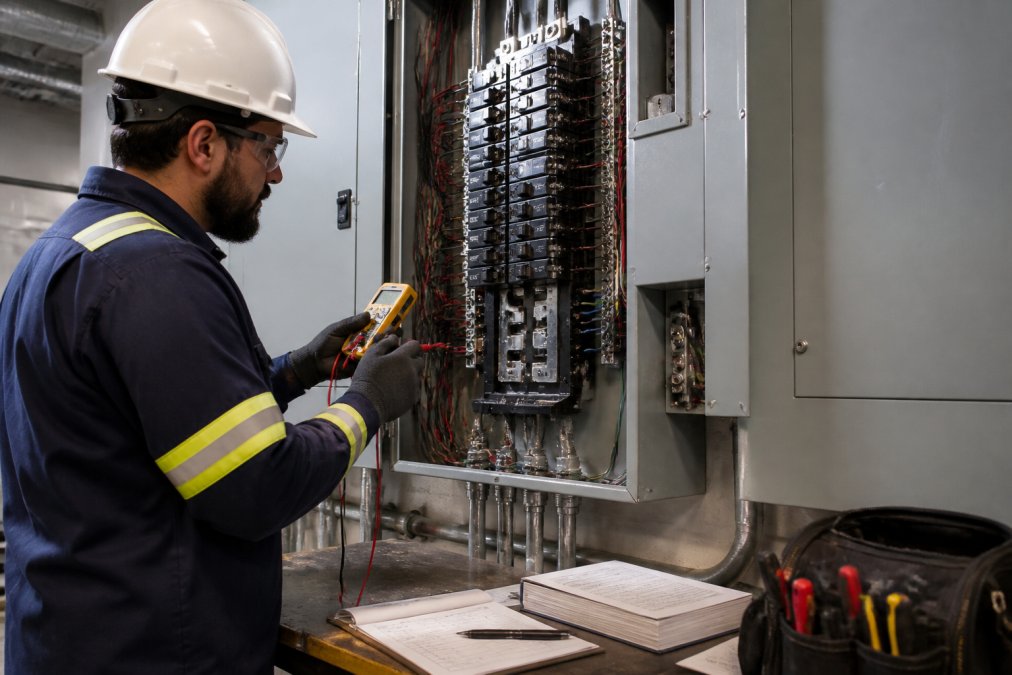
During the Inspection
The inspector examines electrical panels, wiring methods, grounding systems, equipment installation, and safety devices. They verify that components are properly rated, installed according to code, and maintained in safe condition. Testing may include megohm testing of insulation, ground resistance testing, and arc flash hazard analysis.
The inspector documents findings systematically: what they observed, where violations exist, what code sections apply, and what remediation is needed. This documentation becomes your action plan for corrections. A professional inspection takes time, rushing through an inspection guarantees missed violations.
Post-Inspection Documentation
After the inspection, you receive a detailed report listing violations, their severity, required corrective actions, and recommended timelines. Violations fall into categories: immediate safety hazards requiring urgent correction, code non-compliance requiring correction within a specific timeframe, and recommendations for improvement.
Create a remediation schedule based on hazard severity. Life-safety violations take priority. Code violations should be corrected before your next inspection cycle. Recommendations can be phased based on budget and operational impact. Track completion of each item and request documentation from your electrician confirming that corrections meet current code.
Legal and Safety Implications of Non-Compliance
Non-compliance with electrical code creates multiple layers of liability. The most obvious is worker safety: electrical hazards cause serious injuries and deaths every year. When an employee is injured due to a known code violation, you face potential OSHA citations, workers’ compensation claims, and civil liability.
Beyond injury liability, code violations expose you to regulatory action. Building inspectors, fire marshals, and electrical inspectors have authority to issue citations and require corrections. Violations discovered during permit applications can delay projects and trigger costly retrofitting. Insurance companies may deny claims related to electrical incidents if inspections reveal code violations, leaving you to cover losses out of pocket.
There’s also the operational impact. Equipment failures due to inadequate protection can shut down operations, damage inventory, or create emergency situations. A facility fire originating from electrical causes is catastrophic, and if investigation reveals code violations, you face criminal liability in addition to civil damages.
Many business owners underestimate the financial cost of non-compliance. A single serious electrical incident, a worker injury, a facility fire, or extended downtime, costs far more than proactive compliance. The investment in proper inspection, maintenance, and correction is insurance against these catastrophic scenarios.
Hiring a Licensed Commercial Electrician
Your electrician is your primary resource for achieving and maintaining electrical code compliance. The wrong choice, someone cutting corners to save money, undermines your entire compliance program. The right choice provides expertise, accountability, and peace of mind.

A licensed commercial electrician has passed rigorous exams demonstrating knowledge of the NEC, local codes, and safe work practices. They carry liability insurance protecting you if something goes wrong during their work. They understand the difference between “it works” and “it’s code-compliant”, a critical distinction many unlicensed workers miss.
When evaluating electricians, verify their license status with your state’s licensing board. Ask for references from other commercial clients and follow up with those references. Understand their approach to code compliance: do they reference specific code sections in their proposals? Do they recommend testing and documentation? Do they stay current with code changes?
Voltedge Electrical maintains licenses and insurance across all service areas, and our team stays current with code updates and industry best practices. We provide detailed documentation of all work, ensuring you have proof of compliance for inspections and insurance purposes. Our 24/7 availability means you can address electrical emergencies before they become code violations or safety hazards.
Steps to Achieve and Maintain Electrical Code Compliance
Compliance is a process, not a destination. The following steps create a framework for achieving and maintaining code compliance over time.
Conduct a Comprehensive Audit
Start with a baseline assessment of your current electrical system. Hire a qualified electrician to perform a detailed inspection and testing. This audit identifies all violations, deficiencies, and areas at risk. The audit becomes your roadmap for corrections.
During the audit, document the age and condition of major components: panels, transformers, wiring, grounding systems, and protection devices. Understand which violations are immediate safety hazards and which represent code non-compliance that can be corrected on a longer timeline. Prioritize based on risk and operational impact.
Address Violations Systematically
Create a remediation plan that prioritizes life-safety violations, followed by code non-compliance, followed by recommendations. Assign responsibility and timelines for each item. This prevents violations from slipping through the cracks.
Work with your electrician to understand why each violation exists and what the proper correction entails. Some violations require simple fixes; others involve significant work. Understand the cost and timeline for each correction so you can budget appropriately and plan operational impacts.
Implement Preventative Maintenance
Regular maintenance prevents violations from developing. Thermal imaging of electrical panels identifies overheating components before they fail. Megohm testing of insulation detects deterioration early. Load analysis ensures that your system isn’t operating beyond its capacity.
Schedule maintenance on a regular cycle, quarterly or semi-annually depending on facility size and complexity. Document all maintenance work. This creates a record demonstrating your commitment to compliance and provides early warning of developing problems.
Stay Current With Code Changes
The NEC updates every three years. Your local jurisdiction may adopt new amendments. Subscribe to updates from your local building department and electrical inspector. Review changes that affect your facility type and systems.
When code changes affect your facility, work with your electrician to assess compliance. Some changes may not require immediate action; others may create new violations requiring correction. Staying informed prevents surprises during inspections.
Conclusion
Electrical code compliance for businesses is fundamentally about creating a safe, reliable electrical system that protects your people and assets. The process requires understanding current standards, conducting regular inspections, addressing violations systematically, and maintaining ongoing vigilance as codes evolve.
The investment in proper electrical code compliance pays dividends through reduced injury risk, avoided regulatory penalties, and operational reliability. When you’re ready to assess your facility’s compliance status or address violations, Voltedge Electrical provides comprehensive inspections, expert remediation, and ongoing maintenance to keep your electrical system safe and code-compliant. Our licensed electricians understand the nuances of commercial electrical systems and local requirements. Inquire now to schedule a compliance assessment and take control of your electrical safety.
| Compliance Phase | Key Actions | Timeline | Responsibility |
|---|---|---|---|
| Assessment | Conduct comprehensive audit, document violations | 1-2 weeks | Licensed electrician |
| Planning | Prioritize violations, create remediation schedule | 1 week | Facility manager + electrician |
| Correction | Address violations systematically by priority | Varies | Licensed electrician |
| Maintenance | Schedule regular inspections and testing | Ongoing | Facility manager |
| Verification | Document completion, maintain compliance records | Continuous | Facility manager |
Request detailed documentation from your electrician for all compliance work. This documentation, inspection reports, test results, and correction records, proves compliance to inspectors and insurance companies if questions arise later.
Deferring electrical code corrections creates compounding liability. A violation discovered during an incident investigation becomes evidence of negligence. Address violations promptly rather than hoping they won’t be discovered.
Frequently Asked Questions
What are the most common commercial electrical code violations?
The most frequent violations include improper grounding and bonding, inadequate arc flash protection, incorrect circuit breaker sizing, insufficient emergency lighting, and improper wiring methods. Grounding issues account for a significant portion of violations because they directly impact worker safety and equipment protection. Many businesses operate with outdated electrical infrastructure that doesn’t meet current National Electrical Code standards, creating fire and shock hazards.
How often should a business undergo a commercial electrical safety inspection?
Most businesses should have a comprehensive electrical inspection annually, though high-risk facilities like manufacturing plants may need inspections every six months. New businesses should complete an inspection before occupancy. After any significant electrical work, renovation, or equipment installation, a follow-up inspection is essential. Regular inspections catch developing issues before they become safety hazards or compliance violations.
What is the role of the National Electrical Code in business operations?
The NEC establishes the minimum safety standards for electrical installation and maintenance across all commercial buildings. It covers everything from wiring methods and grounding requirements to circuit protection and emergency systems. Compliance with the NEC protects your employees, reduces fire risk, prevents equipment damage, and ensures your facility meets insurance and legal requirements. The NEC is updated every three years to incorporate new safety research and technology advances.
What are the consequences of non-compliance with electrical codes for businesses?
Non-compliance creates multiple risks: potential fines from code enforcement, liability for workplace injuries, voided insurance coverage in case of electrical incidents, facility shutdowns during inspections, and difficulty selling or leasing the property. A single electrical fire or worker injury linked to code violations can result in significant legal liability. Beyond penalties, non-compliance increases operational downtime, equipment failures, and damage to your business reputation.
How do I know if an electrician is properly licensed and insured?
Ask for their license number and verify it with your state’s licensing board or electrical contractor regulatory agency. Request proof of liability insurance and workers’ compensation coverage. Licensed electricians have completed apprenticeships, passed exams, and maintain continuing education. Insurance protects you if something goes wrong during the work. Never hire an unlicensed contractor for electrical work, regardless of cost savings, the liability exposure far outweighs any upfront savings.
What should I expect during an electrical code compliance audit?
A thorough audit examines your electrical panel, wiring methods, grounding systems, circuit protection, emergency lighting, and equipment labeling. The electrician tests circuits, checks load calculations, verifies proper bonding, and reviews documentation. They’ll identify violations, assess safety risks, and prioritize necessary upgrades. The audit results provide a roadmap for achieving compliance, including estimated timelines and costs for remediation work.
Can an older electrical system be brought into code compliance, or do I need a complete replacement?
Most older systems can be upgraded to compliance without complete replacement. Strategic upgrades might include panel modifications, circuit breaker updates, grounding improvements, and wiring corrections. The scope depends on the system’s condition and the violations found. A licensed electrician can assess your specific situation and recommend cost-effective solutions that address safety concerns while preserving functional infrastructure where possible.
This article was written using GrandRanker
