


Table of Contents
- When an Electrical Permit Is Required for EV Charger Installation
- What Happens If You Install an EV Charger Without a Permit
- The Average Timeline for EV Charger Installation: From Permit to Power
- Why You Need a Licensed Electrician for EV Charger Work
- When a Residential Electrical Panel Upgrade for EV Charging Is Necessary
- HOA Rules, Multi-Unit Dwellings, and Retrofitting vs. New Construction
- Frequently Asked Questions
Last Updated: September 15, 2026
When an Electrical Permit Is Required for EV Charger Installation
If you’re asking “do I need an electrical permit for charger installation,” the short answer is almost always yes. Most jurisdictions require an electrical permit for any new 240V circuit, and EV charger installation falls into that category.
An electrical permit is an official authorization from your local building department that allows electrical work to proceed and ensures it meets safety codes. According to National Electrical Code overview, EV charging equipment must be installed according to specific wiring and protection standards.
This guide covers when permits are required, what happens if you skip them, and how the process works, including the permit triggers most homeowners miss and the scenarios where you might be exempt.
The key distinction comes down to how your charger connects to power.
Plug-In vs. Hardwired: Why the Difference Matters
A plug-in charger uses an existing outlet, typically a NEMA 14-50 receptacle. A hardwired charger connects directly to your electrical panel through a dedicated circuit.
Here’s what most guides get wrong: even plug-in units usually require a permit because the outlet must be installed on a new circuit. The permit isn’t for the charger, it’s for the electrical work behind it.
| Installation Type | Permit Typically Required? | Why |
|---|---|---|
| Hardwired charger (new circuit) | Yes | New circuit, panel connection, inspection needed |
| Plug-in charger (new 240V outlet) | Yes | New circuit installation |
| Plug-in charger (existing outlet) | Sometimes | Depends on local rules and circuit capacity |
| Level 1 (standard 120V outlet) | Rarely | No new circuit required |
A common mistake is assuming that because the charger plugs in, no permit is needed. The circuit feeding that outlet still has to be installed, inspected, and approved.
What Happens If You Install an EV Charger Without a Permit
Skipping the permit creates problems that surface long after installation. The immediate risk is a failed inspection when you sell, which can delay or kill a sale.
More seriously, unpermitted electrical work can void your homeowner’s insurance. If a fire originates from that circuit, your insurer may deny the claim because the work wasn’t inspected or approved, a financial exposure most homeowners never consider until it’s too late.
Unpermitted EV charger installations can lead to insurance claim denials if an electrical fire occurs. Your policy likely requires that all electrical work meet local codes and pass inspection.
Local building departments can also require you to remove the installation and start over with proper permits and inspections. Redoing the work far exceeds what the permit would have cost upfront.
The Average Timeline for EV Charger Installation: From Permit to Power
The average timeline for EV charger installation runs 2 to 6 weeks from permit application to final inspection, depending on your jurisdiction’s backlog and whether a panel upgrade is needed. Here’s where projects stall:
Here’s how the process typically breaks down:
- Permit application (1-5 business days): Submit plans and equipment specs to your building department
- Permit approval (1-10 business days): Review time varies widely by jurisdiction
- Installation day (4-8 hours): A licensed electrician runs the circuit and mounts the charger
- Inspection scheduling (3-10 business days): Your jurisdiction sends an inspector
- Final approval (same day as inspection): If everything passes
What You Actually Submit With the Application
A typical residential EV charger permit submittal package includes:
- A one-line electrical diagram showing the new 240V circuit, breaker size, and conductor gauge
- The charger’s manufacturer spec sheet and listing information (UL 2594 for the charging equipment, UL 2231 for the protective components)
- A load calculation worksheet showing the panel can support the added amperage
- Site plan or panel schedule showing where the breaker lands and where the charger mounts
- Contractor license number and, in many jurisdictions, proof of insurance
Missing any one of these is the most common reason a permit sits in review. A complete package submitted on day one beats a partial package submitted three times.
Why Some Permits Take Days and Others Take Weeks
Jurisdictions with over-the-counter or online permitting for standard residential EV circuits issue the same day or within 48 hours. Those that route every residential electrical permit through a plan-review queue, often due to staffing or a simultaneous panel upgrade, add one to three weeks.
Two variables drive most of the variance:
- Panel upgrade included? A service upgrade triggers a separate permit and often a utility coordination step, adding 1-2 weeks.
- Historic district or coastal zone? Overlay requirements can add review layers that have nothing to do with the electrical work itself.
The Inspection Step Most Homeowners Underestimate
Inspection scheduling is where projects quietly lose a week. Inspectors work routes, not on-demand appointments, so the gap between “work complete” and “inspector on site” is often 3-10 business days. If the first inspection fails, usually for a missing grounding electrode conductor, an undersized conductor, or a mismatched load calculation, you re-enter the queue and the clock restarts.
According to U.S. Department of Energy guidance on home charging, planning ahead for permitting is one of the most common delays homeowners encounter. The practical takeaway: submit a complete package, schedule the inspection the moment the rough-in is done, and budget for one re-inspection cycle even on a clean job.
If your project requires a residential electrical panel upgrade for EV charging, add another 1-2 weeks for that separate permit and inspection.
Ask your electrician for the permit number the day it’s issued. A permit number is public record, and it’s the fastest way to confirm the work is actually being done under permit rather than promised to be.
Why You Need a Licensed Electrician for EV Charger Work
A licensed electrician for EV charger installation does more than connect wires: they perform load calculations, verify panel capacity, pull the permit, and ensure the work passes inspection the first time.
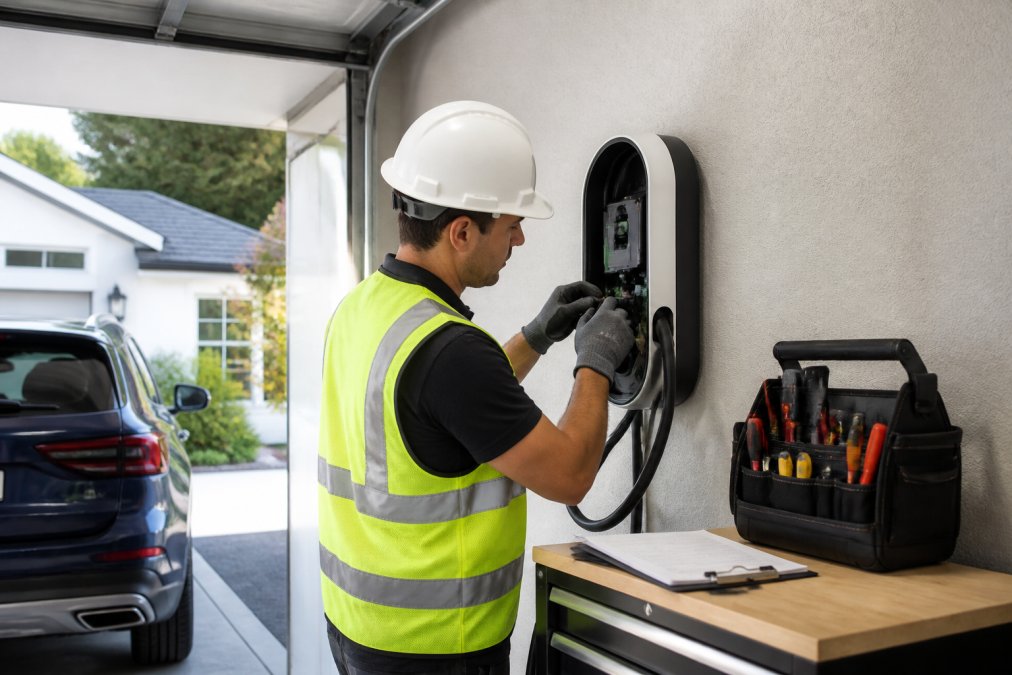
Our licensed and insured electricians handle the entire permitting process, from application to final inspection, and know the local codes, inspectors, and failure points that trip up DIY installations.
The charger itself is the easy part. The hard part is the load calculation, circuit sizing, and grounding requirements inspectors check, a 240V charging circuit draws significant amperage, and your panel must support it alongside everything else in your home.
Ask your electrician whether they pull the permit themselves or expect you to handle it. Reputable contractors include permit coordination in their scope. If they suggest skipping the permit to save time, walk away.
When a Residential Electrical Panel Upgrade for EV Charging Is Necessary
A residential electrical panel upgrade for EV charging becomes necessary when your panel cannot safely support the added load of a 240V circuit, often the case in older homes with 100-amp service.
Your electrician will perform a load calculation adding up all existing appliances, lighting, and outlets, then factor in the new charging circuit. If the total exceeds your panel’s capacity, you have three options:
- Panel upgrade: Replace a 100-amp panel with 200-amp service
- Load management device: A smart splitter that pauses charging when other high-draw appliances run
- Reduced charging amperage: Configure the charger to draw less power
The load management approach works well for homeowners who don’t want the expense of a full panel upgrade. It’s a legitimate code-compliant solution, not a workaround.
We handle panel upgrades and EV charger installations as a single coordinated project, which means one permit, one inspection, and no scheduling gaps between contractors.
HOA Rules, Multi-Unit Dwellings, and Retrofitting vs. New Construction
HOA approval and permit requirements are separate processes, and you may need both before installation begins. Many homeowners assume HOA approval satisfies the permitting requirement. It doesn’t, and in some communities, the HOA is the harder gate.
HOA Approval: A Private Contract, Not a Code Requirement
An HOA’s authority comes from its covenants, conditions, and restrictions (CC&Rs), not the building code.
A few practical patterns worth knowing:
Multi-Unit Dwellings: Where the Permit Path Changes
Retrofitting an Existing Home vs. New Construction
The Insurance Angle Most Guides Skip
The permit isn’t bureaucracy for its own sake. It’s the mechanism that ensures your charging circuit won’t become a fire hazard or an insurance liability, and in an HOA or multi-unit building, it’s only one of several approvals you’ll need.
Frequently Asked Questions
Do you need a permit to install a Tesla charger in Florida?
Yes, in most Florida jurisdictions a permit is required for any Level 2 charger installation, including Tesla Wall Connectors. Whether the unit is hardwired or plugged into a 240V outlet, local building departments treat it as new electrical work. The permit ensures the circuit, breaker, and grounding meet National Electrical Code standards. Skipping it can void your homeowner’s insurance and create problems when you sell the property.
What happens if I install an EV charger without a permit?
Unpermitted installations can lead to fines, forced removal of the equipment, and denied insurance claims if a fire or electrical fault occurs. Your local jurisdiction may also require you to tear out the work and redo it with a licensed electrician, doubling your cost. During a home sale, an inspector or buyer’s agent can flag the unpermitted circuit, delaying or killing the transaction until it is corrected.
Who is responsible for pulling the electrical permit for an EV charger?
In most cases, the licensed electrician performing the work pulls the permit on your behalf. Some homeowners choose to pull their own permit, but many jurisdictions restrict homeowner permits to the primary residence and require the owner to pass the same inspections. If you hire a licensed electrician for EV charger installation, confirm in writing that permit fees and inspection scheduling are included in the scope.
Does a Level 2 charger require a dedicated circuit?
Yes. A Level 2 charger needs a dedicated 240V circuit sized for the charger’s amperage, typically 40 to 60 amps. Sharing an existing circuit with a dryer or range is not code-compliant and creates a fire hazard. The electrician will run a new circuit from your panel, install a properly rated breaker, and verify the load calculation supports the added demand before any permit application is submitted.
