


Table of Contents
- What Causes Burning Smell From Outlets
- Immediate Safety Steps to Take
- Signs of Faulty Electrical Wiring You Should Know
- How to Tell if an Outlet Is Overloaded
- When to Call an Emergency Electrician
- Visual Inspection Checklist for Electrical Safety
- Preventative Maintenance to Avoid Burning Outlets
- Frequently Asked Questions
Last Updated: September 3, 2026
What Causes Burning Smell From Outlets
A burning smell from outlets signals that electrical components are overheating, arcing, or degrading inside your walls or at the outlet itself. The smell typically comes from one of three sources: overloaded circuits pushing too much current through undersized wiring, loose wiring connections creating resistance and heat, or aging electrical panels experiencing thermal degradation over decades of use.
Overloaded circuits and power strips
Overloaded circuits are the most common culprit. Every circuit is designed to safely handle a specific amperage limit, typically 15 amps for standard household outlets or 20 amps for higher-capacity circuits (nfpa.org). When you plug too many devices into a single outlet or use daisy-chained power strips, you force more current through the wiring than it was rated for.
As current exceeds the safe limit, resistance builds up in the wires and connections, generating heat that degrades insulation and produces a distinctive burning plastic smell. Most household outlets are on 15-amp circuits, which safely handle about 1,440 watts continuous load (nfpa.org). High-draw devices like space heaters (750-1,500 watts) and hair dryers (1,000-1,800 watts) can easily overload a standard circuit if other devices are running simultaneously.
Power strips are particularly problematic when daisy-chained, connecting one power strip to another creates a false sense of capacity without actually adding electrical capacity to the circuit. The fix requires either a dedicated higher-capacity circuit or redistributing devices across multiple circuits.
Loose wiring connections and arcing
Loose connections inside outlets or at terminal screws are the second major source of burning smells. Over time, vibration and thermal cycling cause terminal screws to loosen. When a connection loosens, contact resistance increases dramatically, and electrical current arcs across the gap, creating intense localized heat exceeding 3,000 degrees Fahrenheit. This scorches the plastic insulation around the wires and outlet casing.
Loose connections are particularly dangerous because they’re hidden inside the outlet box. A licensed electrician can identify them through visual inspection and thermal imaging. Do not attempt a DIY fix, tightening terminal screws requires disconnecting live wiring, creating serious shock hazards.
Aging electrical panels and thermal degradation
Homes built in the 1970s and earlier often have electrical panels and wiring that are worn out. Copper wiring oxidizes over decades, creating corrosion that increases resistance. Insulation becomes brittle and loses its protective properties. A 50-year-old electrical panel might still function most of the time, but under load it generates more heat than a modern panel would.
This is particularly common in older homes with 100-amp service panels, now often undersized for modern electrical demands. The solution is panel replacement or upgrade, which requires a licensed electrician and often a permit from your local authority.
Immediate Safety Steps to Take
If you smell burning from an outlet, your first priority is preventing a fire.
Stop using the outlet immediately
The moment you detect a burning smell, stop using that outlet and move devices to other outlets on different circuits if possible. This eliminates the load on the problematic circuit and distributes electrical demand more safely.
Unplug devices and turn off the breaker
Unplug all devices from the affected outlet. Then locate your electrical panel and flip the breaker that controls that outlet to the OFF position. This de-energizes the outlet completely, eliminating any risk of arcing or heat generation. If you’re not certain which breaker controls a specific outlet, flip breakers one at a time until the outlet loses power.
Ventilate and monitor for smoke or flames
Open windows and doors to ventilate the area. If you see actual smoke or flames coming from the outlet, evacuate immediately and call emergency services. Do not attempt to extinguish an electrical fire with water. If there’s no visible fire but you smell burning, stay alert for the next few hours. If the smell returns or intensifies, or if you notice discoloration or scorching around the outlet, you have a serious problem requiring immediate professional attention.
Signs of Faulty Electrical Wiring You Should Know
Burning smell is one warning sign, but faulty electrical wiring produces several others. Learning to recognize these signs helps you catch problems before they become emergencies.
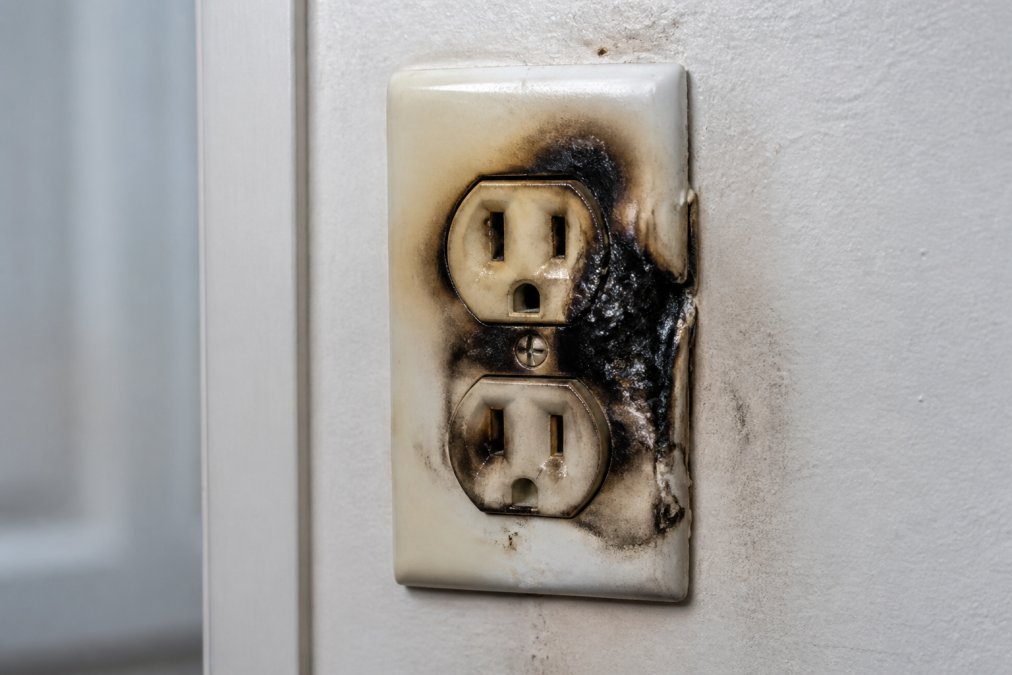
Visual damage and discoloration
Inspect the outlet carefully for discoloration, scorching, or charring on the outlet face, around the screw terminals, or inside the outlet box. Dark spots, black streaks, or brown discoloration indicate heat damage. If the plastic casing has melted, warped, or shows signs of burning, that outlet must be replaced immediately.
Check the wall around the outlet too. If the wall covering shows discoloration or scorching, heat is radiating from inside the wall. Terminal screws that appear loose or corroded need attention. If you can see oxidation (green or white crusty buildup) on the screw terminals, that’s corrosion creating resistance and heat. This requires professional replacement, do not attempt to clean or tighten it yourself.
Flickering lights and buzzing sounds
Flickering lights connected to the same circuit as the problem outlet suggest loose connections or intermittent arcing. A buzzing or humming sound coming from the outlet or wall is another red flag. Any audible sound from an outlet is a sign something is wrong.
Melted casing and scorched plastic
If the plastic outlet casing is soft, melted, or deformed, the outlet has been exposed to extreme heat. This is a clear sign of a serious problem requiring immediate outlet replacement and identification of the underlying cause.
How to Tell if an Outlet Is Overloaded
Determining whether an outlet is genuinely overloaded requires understanding electrical load and amperage limits.
Understanding electrical load and amperage limits
Every outlet is connected to a circuit breaker rated for a specific amperage. Standard household outlets are typically on 15-amp or 20-amp circuits. A 15-amp circuit at 120 volts can safely handle 1,440 watts continuous. A 20-amp circuit can handle 1,920 watts. smoke odor removal.
To calculate the load on a circuit, add up the wattage of all devices running simultaneously on that circuit. If your simultaneous load exceeds these limits, you’re overloading the circuit. Dedicated circuits are recommended for high-draw appliances like window air conditioning units (3,000-5,000 watts).
Daisy-chaining power strips and circuit breaker trips
Daisy-chaining power strips doesn’t increase your circuit’s capacity. You’re still on the same 15-amp or 20-amp circuit. Circuit breaker trips are actually a sign the system is working as designed, the breaker is protecting you by cutting power when the load becomes unsafe. Repeated breaker trips on the same circuit indicate you’re consistently exceeding that circuit’s capacity. The solution is either to reduce the load on that circuit or to have a licensed electrician install a new dedicated circuit for your high-draw devices.
When to Call an Emergency Electrician
A burning smell from an outlet is not a problem that can wait for a scheduled appointment. You need professional assessment quickly, ideally the same day.
Persistent burning smell and active fire hazard signs
If the burning smell returns after you’ve turned off the breaker, or if it persists even when nothing is plugged into the outlet, you have an active problem in your wiring or panel. Any visible smoke, flames, or active fire is an emergency, call 911 first and evacuate the building.
A burning smell combined with a tripped circuit breaker that won’t reset is also an emergency sign. Voltedge Electrical provides 24/7 emergency electrical services because electrical problems don’t follow business hours.
Why ignoring the smell puts your property at risk
Electrical fires are among the most dangerous residential fires. They spread quickly, are difficult to extinguish, and often start inside walls where they’re not visible until significant damage has occurred. The burning smell is your early warning.
Continued use of a faulty outlet accelerates damage. Each time current flows through a loose connection or overloaded wire, the insulation degrades further. What might be a simple outlet replacement if caught early becomes a wall replacement, panel upgrade, or worse if you wait. From an insurance perspective, if a fire starts because you ignored a known electrical hazard, your claim may be denied.
Visual Inspection Checklist for Electrical Safety
Before calling a professional, you can perform a basic visual inspection to gather information about the problem.
Outlet and Surrounding Area:
- Look for any discoloration, scorching, or blackening on the outlet face
- Check if the plastic casing is melted, warped, or soft
- Inspect the wall around the outlet for discoloration or scorch marks
- Look for any visible cracks or damage to the outlet box
- Check terminal screws for corrosion or looseness (do not touch or attempt to tighten)
Wiring and Connections:
- If you can safely access the circuit breaker panel, look for any discoloration or burn marks on the breaker itself
- Check visible wiring for any melted or damaged insulation
- Look for any loose or corroded connections at the outlet (visual inspection only, do not touch)
Smell and Sound:
- Confirm the burning smell is coming from the specific outlet or area you suspect
- Listen for any buzzing, crackling, or humming sounds
- Note whether the smell appears when certain devices are plugged in or running
Circuit Breaker Behavior:
- Note whether the breaker trips frequently
- Check if the breaker is warm to the touch (it should be cool)
- Confirm the breaker switches fully to OFF and back to ON smoothly
This checklist helps you communicate the problem clearly to your electrician.
Preventative Maintenance to Avoid Burning Outlets
The best approach to burning outlets is preventing them in the first place.
Avoid daisy-chaining power strips. If you need more outlets, have a licensed electrician install additional outlets on existing circuits or create new dedicated circuits for high-draw devices. Distribute high-draw appliances across different circuits, don’t run your space heater, hair dryer, and microwave simultaneously on the same circuit.
Have your electrical panel inspected every 5-10 years, especially if your home is older. An inspection can identify loose connections, corrosion, thermal degradation, or undersized capacity before they become fire hazards. Voltedge Electrical offers comprehensive electrical inspections that include thermal imaging to detect hot spots and high-resistance connections invisible to the naked eye.
Check outlets periodically for any signs of damage, discoloration, or looseness. Keep electrical devices clean and well-ventilated. Test ground fault circuit interrupter outlets (GFCIs) monthly by pressing the TEST button to ensure they’re functioning properly.
A burning smell from an outlet is a warning signal your electrical system is in distress. Whether the cause is an overloaded circuit, a loose connection, or an aging panel, the solution requires professional diagnosis and repair. Voltedge Electrical’s licensed electricians have the expertise to identify the root cause quickly and implement a safe, code-compliant solution. We offer 24/7 emergency response because electrical hazards don’t wait for business hours. Contact us today for an inspection or emergency service, your safety is our priority. For more on electrical safety standards, see the National Electrical Code guidelines
Frequently Asked Questions
What should I do immediately if my outlet smells like burning?
Stop using the outlet right away and unplug any devices connected to it. Turn off the circuit breaker for that outlet at your electrical panel. Open windows to ventilate the area and watch for smoke or flames. Do not touch the outlet or attempt to repair it yourself. Contact a licensed electrician or call emergency services if you see fire or smell intensifies. A burning smell from outlets signals a serious fire hazard that requires professional inspection.
Can an outlet cause a fire if nothing is plugged in?
Yes. A burning smell from an outlet can occur even without devices plugged in. Loose wiring connections inside the outlet box, arcing between terminal screws, or aging wiring insulation can generate heat and ignition risk independently. The outlet itself may be the source of the electrical fire hazard due to internal damage, deterioration, or ground faults. This is why any burning smell requires immediate attention and professional evaluation.
What are the signs that an electrical fire is going to start?
Watch for a burning smell from outlets, flickering lights, buzzing or crackling sounds, discoloration or scorch marks around outlets, melted plastic casing, and circuit breaker trips. Heat damage to wiring insulation and carbonization inside the outlet box are warning signs of imminent electrical fire. If you notice multiple warning signs or the burning smell persists after turning off the breaker, evacuate and call emergency services. Never ignore these indicators.
How do I know if my wiring is overheating?
Overheating wiring produces a burning smell, often described as scorched plastic or rubber. You may also notice flickering lights, outlets that feel warm to the touch, or circuit breakers that trip frequently. Overloaded circuits, loose connections, and undersized wire gauge are common causes of thermal degradation. If you suspect overheating wiring, stop using affected outlets and contact a licensed electrician for a safety inspection and testing.
