


Table of Contents
- Why Professional Electrical Inspections Matter More Than Ever in 2026
- The Electrical Safety Inspection Checklist: What a Licensed Electrician Actually Checks
- Signs of Faulty Electrical Wiring You Should Never Ignore
- How Much Does Rewiring a House Cost and What Drives the Price
- Insurance, Resale Value, and Code Compliance: The Financial Case for Inspections
- Smart Home Integration Safety and DIY vs. Professional Work
- What Happens After the Inspection: Documentation and Next Steps
- Frequently Asked Questions
Last Updated: September 12, 2026
Why Professional Electrical Inspections Matter More Than Ever in 2026
A professional electrical inspection is a top-to-bottom evaluation of a property’s wiring, panels, outlets, and safety devices by a licensed electrician, confirming the system can handle modern demand safely. A professional electrical inspection can be a valuable preventative measure for homeowners.
Homes built decades ago were never designed for today’s electrical load. Heat pumps, EV chargers, induction ranges, and always-on smart devices all pull current through wiring sized for a fraction of that demand. The U.S. Fire Administration’s residential fire data points to electrical failure as a recurring cause of home fires, and most of those failures start as small, invisible faults that an inspection catches early.
Below, we’ll show what a licensed electrician checks, how to spot faulty wiring, what drives rewiring costs, and why insurers and buyers care about your report.
The Electrical Safety Inspection Checklist: What a Licensed Electrician Actually Checks
An electrical safety inspection checklist covers three core areas: the service panel and breakers, the grounding and bonding system, and every outlet, switch, and safety device. A thorough inspection produces a written report for your insurer or buyer.
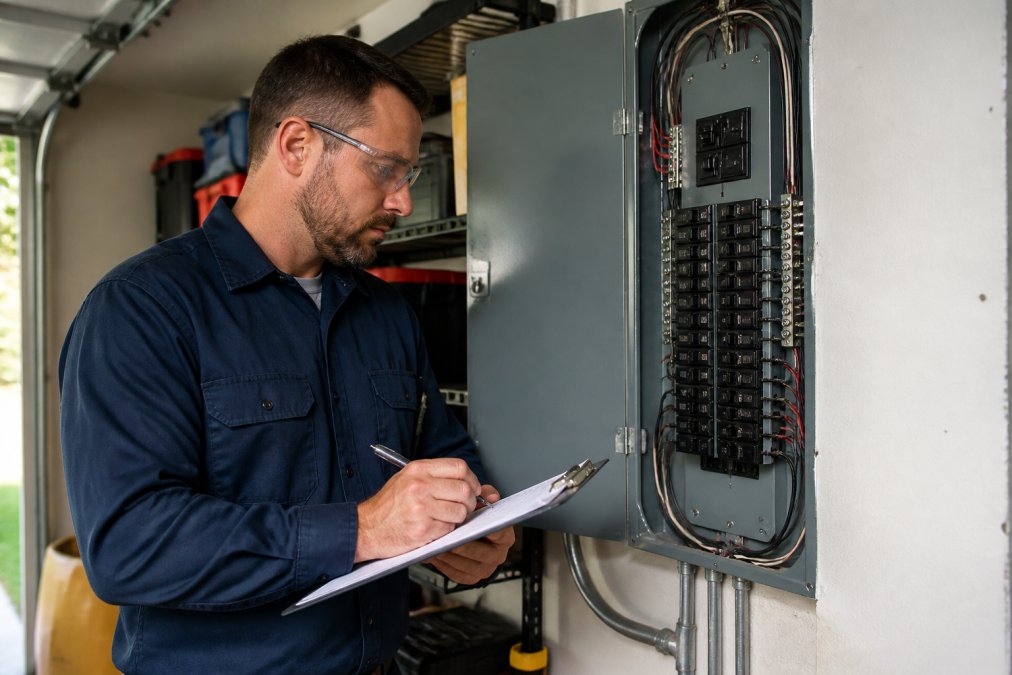
Panel, Breakers, and Grounding
The panel is where most serious problems hide. An electrician checks the main breaker rating against the home’s actual load, looks for double-tapped breakers and scorch marks, and confirms grounding and bonding connections are intact. Grounding gives stray current a safe path to earth instead of through your body, so a loose or corroded ground is a genuine shock hazard.
Outdated electrical panels are a frequent finding in older homes. Federal Pacific and Zinsco panels, common in mid-century construction, have a documented history of failing to trip under fault conditions. When we find one, we recommend replacement, not patching.
Outlets, GFCIs, and AFCIs
Every outlet gets tested for correct polarity, secure connections, and heat damage. GFCI outlets, required in kitchens, bathrooms, garages, and outdoors, cut power when current leaks to ground. AFCI breakers protect against arc faults, the small sparks inside damaged wiring that ignite framing lumber.
Many older homes have neither. Adding GFCI and AFCI protection is one of the highest-value upgrades an inspection can uncover, addressing both shock and fire hazards.
Signs of Faulty Electrical Wiring You Should Never Ignore
The signs of faulty electrical wiring include warm or discolored outlet covers, a burning smell near switches, flickering lights not tied to one appliance, and breakers that trip repeatedly. Any one means the circuit should be tested before further use.
What most guides miss is that faulty wiring often gives no warning at all. Aluminum branch wiring, common in homes built in the late 1960s and 1970s, can loosen at connections over decades and overheat silently inside the wall. The same is true of backstabbed outlets, where wire is pushed into a spring clip instead of secured under a screw.
A common mistake is resetting a tripping breaker and moving on. A breaker that trips is doing its job. If it trips twice, stop resetting it and get the circuit diagnosed.
Never ignore a breaker that trips repeatedly or an outlet that feels warm to the touch. Both indicate resistance heating inside the circuit, and resistance heating is how electrical fires start.
How Much Does Rewiring a House Cost and What Drives the Price
How much does rewiring a house cost depends on square footage, wiring accessibility, whether walls are open, and the number of circuits added. Because those variables swing so widely, any single “average” figure online is close to meaningless.
The biggest cost driver is access. An unfinished attic and crawlspace let an electrician run new cable quickly. A finished two-story home with plaster walls means fishing cable through cavities, patching drywall, and repainting, that labor moves the number.
Other factors that change the scope:
- Whole-house rewiring versus replacing only failed circuits
- Panel upgrade to a higher amperage service, often paired with rewiring
- Adding dedicated circuits for EV chargers, heat pumps, or workshop equipment
- Bringing outlets up to current code with GFCI and AFCI protection
- Permit and inspection fees, which vary by jurisdiction
Rather than quote over the phone, we walk the property and give you a written scope.
Insurance, Resale Value, and Code Compliance: The Financial Case for Inspections
Electrical code compliance, insurance eligibility, and resale value are three financial arguments for the same inspection. The difference between a report that helps you and one that sits in a drawer is whether it documents the specific items insurers and buyers ask about.
What Insurers Actually Look At
Most carriers do not send an electrician to your house. They ask questions on the application and, in older homes, order a four-point inspection, a limited review of the roof, HVAC, plumbing, and electrical system, before binding or renewing a policy. Common underwriting triggers on the electrical portion:
- A service panel under 100 amps. Many carriers treat 60-amp service as ineligible or surcharge it, because it cannot carry a modern load.
- Fuse boxes. Remaining fuse panels are frequently declined outright, not surcharged.
- Federal Pacific Stab-Lok and Zinsco panels. These appear on insurer watch lists because of documented failure-to-trip history.
- Knob-and-tube or aluminum branch wiring. Often acceptable only with documentation of remediation.
- Evidence of unpermitted work. A panel with no permit record is a red flag during a claim review.
This is where a licensed electrician’s report earns its keep. A home inspector’s note, “older panel, recommend evaluation by a licensed electrician”, does nothing for an underwriter. A report stating service amperage, panel make and model, grounding and bonding condition, and GFCI/AFCI status answers underwriting questions directly, and if a claim later involves an electrical fire, it is your evidence the system was maintained.
Resale and Disclosure
On the resale side, a home inspection almost always flags electrical items, and vague findings scare buyers and agents. A pre-listing electrical inspection flips the dynamic: instead of a buyer’s inspector generating unknowns, you hand over a documented condition report. If problems surface, you fix them on your schedule and at your price instead of negotiating from weakness.
Disclosure rules matter too. Most states require sellers to disclose known material defects, and a documented but unrepaired electrical fault is exactly that. A repair invoice paired with the original finding is the cleanest paper trail you can leave a buyer.
Code Compliance Is Not Retroactive, But It Still Matters
The National Fire Protection Association’s overview of NFPA 70, the National Electrical Code is the model most jurisdictions adopt, usually with local amendments and a multi-year adoption lag. The NEC is generally not retroactive: an older home is not automatically “illegal” because it predates AFCI requirements. What matters is whether the system is safe and whether new work is permitted and inspected.
That distinction cuts both ways. You need not bring a 1975 house up to current code, but adding a circuit, replacing a panel, or finishing a basement must meet the code in force at permit time. An inspection tells you which items are safety priorities versus simply older-than-current, so you spend on risk instead of paperwork.
An inspection report is a financial document as much as a safety one. It answers underwriting questions, supports your asking price, and creates the disclosure record that protects you after the sale.
Smart Home Integration Safety and DIY vs. Professional Work
Smart home integration safety comes down to one rule: the low-voltage side is DIY, the line-voltage side is not. Smart bulbs, hubs, and plug-in thermostats are fine to install yourself. Smart switches, dimmers, and hardwired doorbell cameras connect to 120-volt wiring inside a box, licensed work. What most guides miss is that smart devices and electrification add continuous load to a panel that may already be near capacity.
The Load Math Nobody Shows You
A circuit breaker is sized for the wire behind it, not the devices you plug in. A 15-amp circuit on 14-gauge wire carries roughly 1,440 watts of continuous load at the 80% rule; a 20-amp circuit on 12-gauge wire carries about 1,920 watts (nfpa.org). A single EV charger on a 240-volt circuit can pull 32 to 48 amps continuously, more than an entire 100-amp service was designed to spare. Add a heat pump, induction range, and always-on hubs and cameras, and baseline draw climbs every year.
That is why an inspection maps your actual load against panel capacity before you add the next device. The answer is often not “you need a full rewire” but “you need a load calculation and possibly a service upgrade.”
EV Chargers and Heat Pumps Change the Panel Conversation
A Level 2 EV charger typically needs a dedicated 240-volt circuit and a 40- to 60-amp breaker. Many older homes have 100-amp service, and after the range, dryer, water heater, and air conditioning, no 40-amp block is left. Options are a 200-amp service upgrade, a load-management device that pauses the charger when the house peaks, or a lower-amperage charger. Each trades off cost, charging speed, and complexity.
Heat pumps and induction ranges raise the same question from a different direction. They are more efficient than the gas and resistance equipment they replace, but still large 240-volt loads, and they often arrive with the EV. An inspection is the moment to plan all three together instead of discovering the limit one breaker trip at a time.
Where the DIY Line Actually Sits
The DIY versus professional distinction matters most where homeowners get overconfident. Replacing a light fixture looks simple until the box is not rated for the fixture’s weight or the wiring is aluminum. Adding a smart switch looks simple until you find no neutral wire, common in older homes. Running a new circuit for a charger is not a homeowner project in any jurisdiction requiring a permit and inspection.
A useful rule: if the task involves opening a panel, adding a circuit, or working inside a box with line voltage, it is licensed and usually permitted work. If it plugs in or screws onto an existing fixture, it is yours to do.
Before buying any smart switch, pull the existing switch plate and check for a white neutral wire in the box. No neutral means most smart switches will not work without new wiring, and knowing that before you buy saves a return trip and a call.
Never add an EV charger, heat pump, or other large 240-volt load by tapping an existing circuit. A load calculation and, in most cases, a permit are required, and an unpermitted circuit can void an insurance claim after a fire.
What Happens After the Inspection: Documentation and Next Steps
Post-inspection documentation is where a good electrical inspection earns its keep. You should receive a written report listing each finding, its severity, and a recommended fix, with photos of anything flagged. Keep it, it becomes your maintenance record, insurer evidence, and disclosure document if you sell.
Environmental impact belongs in the conversation too. An aging electrical system wastes energy through resistance heating at loose connections and undersized conductors, and limits your ability to add efficient electric systems like heat pumps and induction cooking. Upgrading electrical infrastructure is often the prerequisite for lowering a home’s overall energy consumption.
Preventative maintenance on the electrical system follows the same logic as servicing a car. A periodic inspection catches worn breakers, loose terminations, and overloaded circuits while they are still cheap to fix. Electrical system longevity is not luck; it is maintenance.
| Inspection Finding | Why It Matters | Typical Fix |
|---|---|---|
| Double-tapped breaker | Overheats the breaker terminal | Add a circuit or install a tandem breaker |
| Missing GFCI protection | Shock hazard in wet areas | Install GFCI outlets or breakers |
| No AFCI protection | Arc faults can start fires | Install AFCI breakers |
| Aluminum branch wiring | Loose connections overheat | Re-terminate or rewire the circuit |
| Undersized service panel | Cannot carry modern load | Panel upgrade to higher amperage |
| Poor grounding or bonding | Shock and surge risk | Repair ground electrode and bonds |
If your inspection turns up a list like this, the fix is not always a full rewire. Often it is a panel upgrade, new safety devices, and targeted circuit repairs, which a licensed electrician can sequence by risk so you spend where it counts first.
Older electrical systems rarely fail loudly; they fail quietly until the day they don’t. If your home predates modern codes, if your panel is original, or if you’re adding an EV charger, a heat pump, or a stack of smart devices, get the system evaluated before you add more load. Voltedge Electrical provides licensed and insured electricians, 24/7 emergency support, and up-to-date knowledge of current codes and technologies, with customized solutions built around your property. Get started with Voltedge Electrical and schedule a professional electrical inspection so you can power your home safely and efficiently.
Frequently Asked Questions
What is included in a professional electrical inspection?
A professional electrical inspection covers the main panel, circuit breakers, wiring integrity, grounding, outlets, GFCIs, AFCIs, and visible connections. The electrician checks for code compliance, signs of overheating, and proper load distribution. You receive a written report documenting findings, photos, and recommended repairs. This documentation is useful for insurance, real estate, and planning future upgrades.
How often should you have an electrical inspection?
Most homes benefit from an inspection every 3 to 5 years, or sooner if the home is over 40 years old, has had major renovations, or you notice flickering lights, warm outlets, or burning smells. New homeowners should schedule one before moving in. Property managers often set annual or biennial inspections to stay ahead of maintenance and insurance requirements.
Do electrical inspections increase home value?
Yes, a documented inspection can support a higher resale value because buyers and agents view it as proof of a well-maintained electrical system. It can also reduce negotiation friction by showing that the panel, wiring, and safety devices meet current standards. Sellers who complete recommended repairs before listing often see faster closings and fewer contingency issues.
Can an electrical inspection find hidden wiring issues?
An inspection can identify many hidden issues through thermal imaging, voltage testing, and physical checks at accessible points, but it cannot see inside every wall without opening them. Inspectors look for symptoms like voltage drops, hot spots, and improper splices. If problems are suspected behind finished surfaces, the electrician will recommend targeted investigation or rewiring.
