


Table of Contents
- What Counts as a 24/7 Electrical Emergency
- Signs of Electrical Emergency Every Homeowner Should Know
- Emergency Electrician Cost: What Drives the Price
- Hiring a Licensed Electrician for Emergency Repairs
- DIY Safety Triage: What to Do Before Help Arrives
- Electrical Fire Prevention Checklist
- Frequently Asked Questions
Last Updated: September 11, 2026
What Counts as a 24/7 Electrical Emergency
A 24/7 electrical emergency is any fault that threatens life or property and cannot safely wait for a business-hours appointment. At Voltedge Electrical, we apply three tests: Is there fire risk? Is anyone exposed to live current? Is critical equipment failing right now? If yes to any, you need an emergency electrician service 24 7 availability, not a callback on Tuesday morning.
The distinction matters because it determines who you call and how fast you should expect a response. The U.S. Fire Administration’s residential fire data consistently identifies electrical faults as a leading cause of home fires, and most start small: a warm outlet, a faint burning smell, a breaker that trips twice in one evening.
Situations That Need Immediate Help
Call now if you see any of the following:
- Sparking outlets or visible arcing at a receptacle or switch
- A burning smell near an outlet, panel, or appliance cord
- Buzzing or crackling from the electrical panel
- Water contacting live wiring after a leak or storm
- A shock felt when touching an appliance or fixture
- Total power loss with no obvious utility outage in the area
Each points to a fault inside your wiring or panel, not a utility problem. A short circuit or ground fault can escalate to a fire in minutes (usfa.fema.gov).
When You Can Wait Until Morning
Not every issue is an emergency. Flickering lights on one circuit, a single dead outlet, or a breaker that trips once and resets cleanly can usually wait for a scheduled visit, as can cosmetic problems and planned upgrades.
If a breaker trips more than twice in a 24-hour window, stop resetting it. Repeated tripping means the circuit is drawing more current than it should, and each reset adds heat. Book an electrician the same day rather than waiting for it to fail completely.
Signs of Electrical Emergency Every Homeowner Should Know
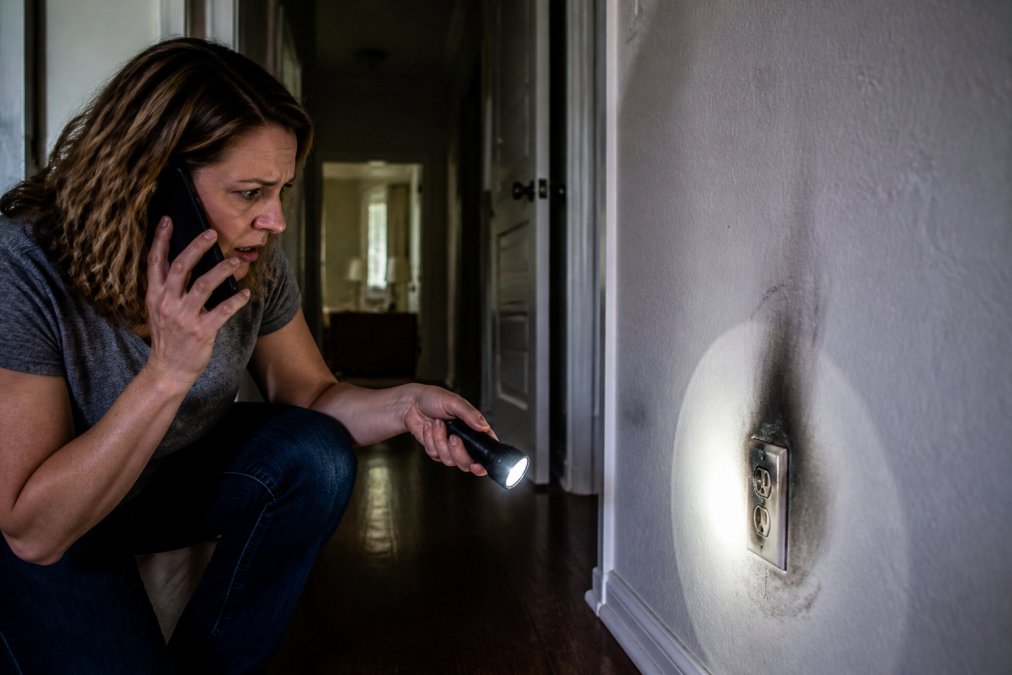
The warning signs of an electrical emergency are usually visible before a failure, so knowing them buys you time. A burning smell near an outlet or panel is the most urgent signal, followed by sparking outlets, discolored wall plates, and flickering lights across multiple fixtures on one circuit.
Warning Signs You Should Never Ignore
Treat these as stop-everything signals:
- Scorch marks or melted plastic around an outlet or switch
- A hot wall plate or panel cover
- Lights that dim noticeably when a large appliance kicks on
- A burning smell with no identifiable source
- Buzzing from a dimmer switch or panel
Voltage fluctuation affecting the whole house, rather than one circuit, often points to a failing main breaker or loose service connection, a panel-level problem you should not troubleshoot yourself.
A common mistake is assuming a warm outlet is normal because it has “always been that way.” Heat at a receptacle means resistance, and resistance means the connection is degrading. It will not fix itself.
Never reset a breaker that trips immediately after being switched back on. An immediate re-trip usually means a short circuit or a ground fault is still active. Forcing it can arc inside the panel, which is where the most dangerous electrical fires begin.
Emergency Electrician Cost: What Drives the Price
Emergency electrician cost is the biggest source of anxiety in this process, and almost no provider explains it honestly. Emergency work is priced differently from scheduled work, and the difference is structural, not arbitrary.
Four variables drive the final number: time of day, fault complexity, parts required, and accessibility behind walls. Time of day is the one homeowners can predict, and the one most providers leave vague until the invoice arrives.
How After-Hours Pricing Is Actually Structured
A standard business-hours call is billed as a diagnostic fee plus an hourly rate, with a one-hour minimum. After-hours pricing layers three components on top:
- A trip or dispatch charge. This covers the technician’s travel and is often waived during business hours but applied on nights, weekends, and holidays.
- A higher hourly rate, sometimes tiered. Many providers charge one rate for weekday evenings, a higher rate for weekends, and the highest for holidays. The tiers are usually published in the provider’s rate sheet, ask for it.
- A minimum labor block. After-hours calls frequently carry a two- or three-hour minimum, even if the repair takes twenty minutes. This is the line item that surprises homeowners most.
Typically the after-hours labor premium runs higher than the daytime rate, and the trip charge is added on top rather than folded in. Multipliers vary by market and provider, so the only reliable number is the one quoted before dispatch.
Why Diagnostic Time Is the Wild Card
Tracing a fault through an older system takes longer than replacing a known part. A tripped breaker and a failed main panel are both “electrical emergencies,” but one may be a fifteen-minute reset and inspection while the other is a multi-hour panel replacement requiring a permit and return visit.
No responsible provider quotes a flat number before diagnosing the fault. A responsible provider quotes the diagnostic fee and hourly rate up front, then confirms any change before proceeding.
The Three Numbers to Get Before Anyone Starts Work
Most homeowners worry about surprise charges once the walls come open. The fix is procedural: before authorizing any work, get these three numbers in writing or by text:
- The diagnostic fee, what you pay just to have the fault identified, whether or not you approve the repair.
- The after-hours hourly rate, and whether a minimum labor block applies.
- The parts markup policy, whether materials are billed at cost plus a percentage or at a flat retail rate.
Ask one more question on top of those three: Will I be told before any work exceeds the original estimate? A transparent provider will answer yes and put it in writing.
Ask four questions before you book: What is the diagnostic fee? What is the after-hours hourly rate and is there a minimum labor block? What is the parts markup? Will I be notified before work exceeds the estimate? Any provider unwilling to answer all four is a risk.
What Insurance May Cover
Whether your homeowners policy reimburses an emergency electrical repair depends on the cause of the failure, not the size of the bill.
- Sudden and accidental failures, a short circuit that damages wiring, a surge that destroys a panel, are the type of event policies are typically written to cover.
- Damage from neglected maintenance, a panel that has been overheating for years, aluminum wiring that was never remediated, is commonly excluded as a maintenance issue rather than a sudden loss.
- The repair itself versus the resulting damage are often treated separately. A policy may cover water damage from a burst pipe but not the electrical repair that preceded it, or vice versa.
The practical move: photograph the damage before repairs begin, keep the electrician’s written diagnosis, and call your insurer’s claims line before authorizing work if the bill will likely exceed your deductible. Documentation taken before repairs is what claims adjusters use and is nearly impossible to reconstruct afterward.
Do not authorize repairs before checking whether your policy requires prior approval or a preferred-contractor network. Some insurers will only reimburse work performed by a licensed contractor who pulled the required permit, and unpermitted work can void the claim entirely.
Hiring a Licensed Electrician for Emergency Repairs
Hiring a licensed electrician for emergency repairs protects you legally and financially, because unpermitted and unlicensed work can void insurance coverage and fail inspection later. Licensing is set at the state and local level, and you can verify a contractor through your state’s licensing board before anyone arrives, even at 2 a.m., since most boards maintain online lookup tools.
How to Verify Credentials Before You Book
Verification takes about five minutes and prevents the most expensive mistake in this process. What each step proves:
- Confirm the license number with your state licensing authority. Ask for the license number, not just the company name, and look it up yourself. A license tied to the company rather than the individual technician matters, confirm the person arriving is covered.
- Ask for a certificate of insurance showing general liability and workers’ compensation. General liability covers damage to your property; workers’ compensation covers the technician if they are injured on your job. If a technician is hurt in your home without workers’ comp, the claim can come back to you.
- Confirm the technician is background-checked if the provider advertises it. This matters most for after-hours calls, when you are letting a stranger into your home at night.
- Get the diagnostic fee and hourly rate in writing before dispatch, not after arrival.
- Ask whether permits are pulled for panel or circuit work. Permitted work is inspected, and inspection is what your insurer relies on if there is a later claim.
The U.S. Consumer Product Safety Commission guidance on electrical safety is clear that DIY work on live circuits is a leading cause of serious injury. Even a job that looks simple, like swapping a breaker, involves an open panel and live bus bars.
Why Unpermitted Work Is the Real Risk
The license and the permit are different things, and homeowners often conflate them. A licensed electrician can still perform unpermitted work, and that is where the financial exposure lives:
- Insurance claims can be denied. If a fire is traced to wiring that was never inspected, the insurer may treat the cause as a code violation rather than a covered loss.
- A home sale can stall. Inspectors flag unpermitted electrical work during a real estate transaction, and the buyer’s lender may require it to be brought to code before closing.
- The work may have to be redone. Bringing unpermitted work to code often means opening walls to expose the wiring for inspection, a far larger job than the original repair.
The cheapest after-hours quote is often the one that skips the permit. The savings are real in the moment and disappear the first time the work is inspected.
What to Ask on the Call Itself
Because emergency calls happen under time pressure, verification must be fast. Three questions cover most of the risk:
- What is your license number, and who is the licensed electrician of record for this job?
- Are you insured for both general liability and workers’ compensation, and can you text me the certificate?
- Will you pull a permit for this work, and is the permit fee included in the estimate?
Voltedge Electrical keeps licensed and insured electricians on staff, confirms credentials on request, and pulls permits for panel and circuit work so the job passes inspection the first time. That removes the guesswork from the checklist above.
Save your state licensing board’s lookup URL to your phone’s home screen before you need it. In an emergency you will be comparing quotes under pressure, and having the verification tool one tap away is the difference between checking and hoping.
DIY Safety Triage: What to Do Before Help Arrives
DIY safety triage means making the property safe without touching the electrical system itself. Your job in the first five minutes is containment, not repair.
Do this, in order:
- Kill power at the breaker if you can reach the panel safely. If the panel is hot, sparking, or smoking, do not touch it.
- Evacuate if you see flames or smell burning insulation. Call 911 first, then the electrician.
- Unplug nothing that is smoking or arcing. Pulling a live cord can trigger an arc.
- Keep water away from the affected area. Do not spray or pour anything on an electrical fire.
- Photograph the damage once the area is safe, for your insurance claim.
That last step matters: documentation taken before repairs begin is what insurers use to process a claim, and it is nearly impossible to reconstruct afterward.
Know where your main breaker is before you need it. In an emergency, you will be looking for it in the dark, possibly with smoke in the room. Walk the route once now and label the panel.
Electrical Fire Prevention Checklist
Electrical fire prevention comes down to catching degradation before it becomes ignition. Most electrical fires are preventable, and the checks take minutes.
| Check | How Often | Warning Sign to Watch For |
|---|---|---|
| Test GFCI and AFCI outlets | Monthly | Fails to trip when tested |
| Inspect cords and plugs | Monthly | Fraying, heat, discoloration |
| Check panel for heat or buzzing | Quarterly | Warm cover, buzzing, rust |
| Professional electrical inspection | Every few years | Age, aluminum wiring, DIY additions |
| Verify surge protection | Annually | No protection on main panel |
| Clear space around panel | Ongoing | Storage blocking access |
Surge protection at the panel protects sensitive electronics from voltage fluctuation but does not prevent fires from faulty wiring. A whole-house surge protector handles grid spikes; an inspection handles the wiring inside your walls.
Older homes are the highest-risk category. A 100-amp panel from decades past may still function but may be running at capacity with modern loads it was never sized for. Have that conversation with an electrician before something fails, not after.
Frequently Asked Questions
What constitutes an electrical emergency?
An electrical emergency is any situation that poses an immediate risk of fire, shock, or injury. This includes sparking outlets, burning smells from wiring or fixtures, smoke coming from an electrical panel, exposed live wires, and repeated circuit breaker trips that won’t reset. If you see flames or smell burning plastic, call 911 first, then contact a 24/7 emergency electrician. Situations like a single flickering light or one dead outlet can usually wait for a scheduled visit during normal business hours.
How much does an emergency electrician cost after hours?
Emergency electrician cost depends on several factors: the time of day, the complexity of the repair, parts needed, and your location. After-hours, weekend, and holiday calls typically carry higher rates than standard business-hour service. Most providers charge a service call fee plus hourly labor. Because pricing varies by job and provider, ask for a clear estimate before work begins. Voltedge Electrical provides transparent quotes so you know what to expect before any work starts.
Can I fix a sparking outlet myself?
No. A sparking outlet is a sign of electrical emergency that should only be handled by a licensed electrician. Turning off the breaker to that outlet is the one safe step you can take. Do not remove the outlet cover, touch the wiring, or attempt a DIY repair. Faulty wiring, loose connections, or a short circuit could be the cause, and any of these can lead to a fire. Call a 24/7 emergency electrician and keep everyone away from the outlet until help arrives.
How do I know if my electrical panel is failing?
Common signs include breakers that trip repeatedly, a burning smell near the panel, scorch marks on the panel door, flickering lights across multiple rooms, and buzzing or crackling sounds. If your home has a 100-amp panel and you’ve added major appliances over the years, it may be overloaded. A licensed electrician can inspect the panel and tell you whether a repair or upgrade is needed. Never open the panel yourself; the main service lines remain live even when the main breaker is off.
